New Global Burden of CVD Report Shows Wide Variation Among Countries
Cardiovascular disease remains the leading cause of disease burden, causing one in three deaths worldwide, according to the latest Global Burden of Disease study report published Sept. 24 in JACC and presented during a special side event as part of the 80th Session of the United Nations General Assembly in New York. According to the authors, large variations in this burden exist even among countries with similar economies.
The new report assesses the burden of 376 diseases including cardiovascular disease from 1990 to 2023 across 204 countries using all available data and statistical models. Authors identified potential drivers including population growth, population aging and risk factor exposure.
Overall results found cardiovascular disease continues to be the leading cause of disability-adjusted life years (DALYs) and deaths globally. All told, there were 437 million cardiovascular disease DALYs in 2023, a 1.4-fold increase from the 320 million cardiovascular disease DALYs in 1990. Cardiovascular disease was also responsible for 19.2 million deaths in 2023, an increase from 13.1 million in 1990, with ischemic heart disease, intracerebral hemorrhage, ischemic stroke and hypertensive heart disease among the leading causes. A 16-fold difference was observed between the countries with the lowest and highest cardiovascular disease DALY rates.
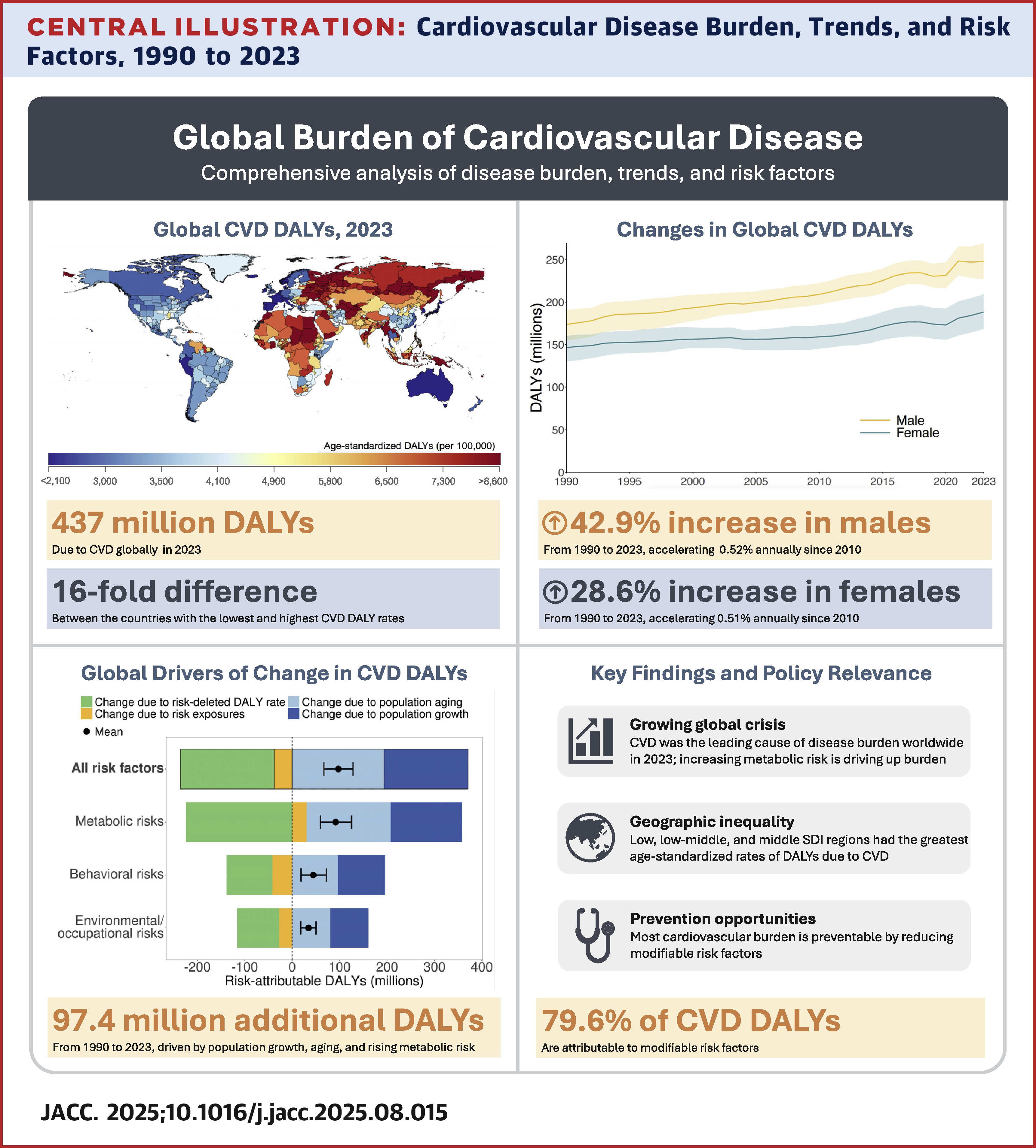
"The finding that [cardiovascular disease] burden is substantially greater outside of the most developed settings even after accounting for differences in population age, remains among the most important messages of this analysis," said Gregory A. Roth, MD, MPH, FACC, senior author of the paper. "Our analysis shows wide geographic differences in [cardiovascular disease] burden that can't be explained by income level alone. Given this kind of variation, our findings offer the opportunity to tailor local health policies to target the most relevant risks for specific populations."
In other findings, 79.6% of all cardiovascular disease DALYs globally in 2023 were attributable to modifiable risk factors, an increase of 97.4 million since 1990 largely due to population growth and aging. Metabolic risk factors like high body mass index (BMI) and high fasting plasma glucose ranked the highest (67.3%), followed by behavioral factors (44.9%) and environmental/occupational factors like air pollution, lead exposure and higher temperatures (35.8%).
Researchers also noted that higher cardiovascular mortality rates were observed in men than women in most regions, and risk increased steeply after age 50. Tobacco use, poor diet, low physical activity, and high alcohol consumption continue to contribute significantly to the global toll, particularly for ischemic heart disease and atrial fibrillation.
"This report is a wake-up call: heart disease remains the world's leading cause of death, and the burden is rising fastest in places least equipped to bear it," said Harlan M. Krumholz, MD, SM, FACC, JACC Editor-in-Chief. "The good news is we know the risks and how to address them; if countries act now with effective health policies and systems, millions of lives can be saved."
Launched in 2020, the Global Burden of Cardiovascular Diseases Collaboration is an alliance between JACC, the Institute for Health Metrics and Evaluation at the University of Washington, and the National Heart, Lung, and Blood Institute. The collaboration provides the latest findings and resources to assist with targeted efforts to decrease the burden of cardiovascular disease in regions around the world.
Clinical Topics: Cardiovascular Care Team
Keywords: Cardiovascular Diseases, Global Burden of Disease, Quality Indicators, Health Care, Heart Diseases, Health Policy
< Back to Listings


