Nearly Everyone Has One or More CV Risk Factors Before a CVD Event
Almost all individuals (99%) who experienced a cardiovascular disease event were exposed to one or more nonoptimal traditional risk factor, challenging the belief that cardiovascular disease often strikes people without warning, according to a large study published Sept. 29 in JACC.
Hokyou Lee, MD, PhD, et al., analyzed health records from two prospective cohorts in Korea (Korean National Health Insurance Service [KNHIS]) and one from the U.S. (Multi-Ethnic Study of Atherosclerosis [MESA]). The KNHIS cohort included 9,341,100 individuals ≥20 years old at baseline and followed from 2009 to 2022. The MESA cohort included 6,803 individuals aged 45-84 years at baseline and followed from 2000 to 2019.
The researchers looked at individuals who had a first cardiovascular disease event during follow-up, defined as coronary heart disease (CHD), heart failure (HF), myocardial infarction (MI) or stroke. Then they determined the prevalence of one or more traditional cardiovascular risk factors at nonoptimal levels before the event, including: 1) systolic blood pressure (BP) ≥120 mm Hg or diastolic BP ≥80 mm Hg or on treatment; 2) total cholesterol ≥200 mg/dL or on treatment; 3) fasting glucose ≥100 mg/dL, diagnosis of diabetes or on treatment; or 4) past or current tobacco use.
Results showed that 601,025 and 1,188 cardiovascular disease events occurred in the KNHIS and MESA cohorts, respectively. There was a high prevalence of risk factors in both the KNHIS and MESA cohorts, respectively: 99.7% and 99.6% before CHD, 99.4% and 99.5% before HF, and 99.3% and 99.5% before stroke.
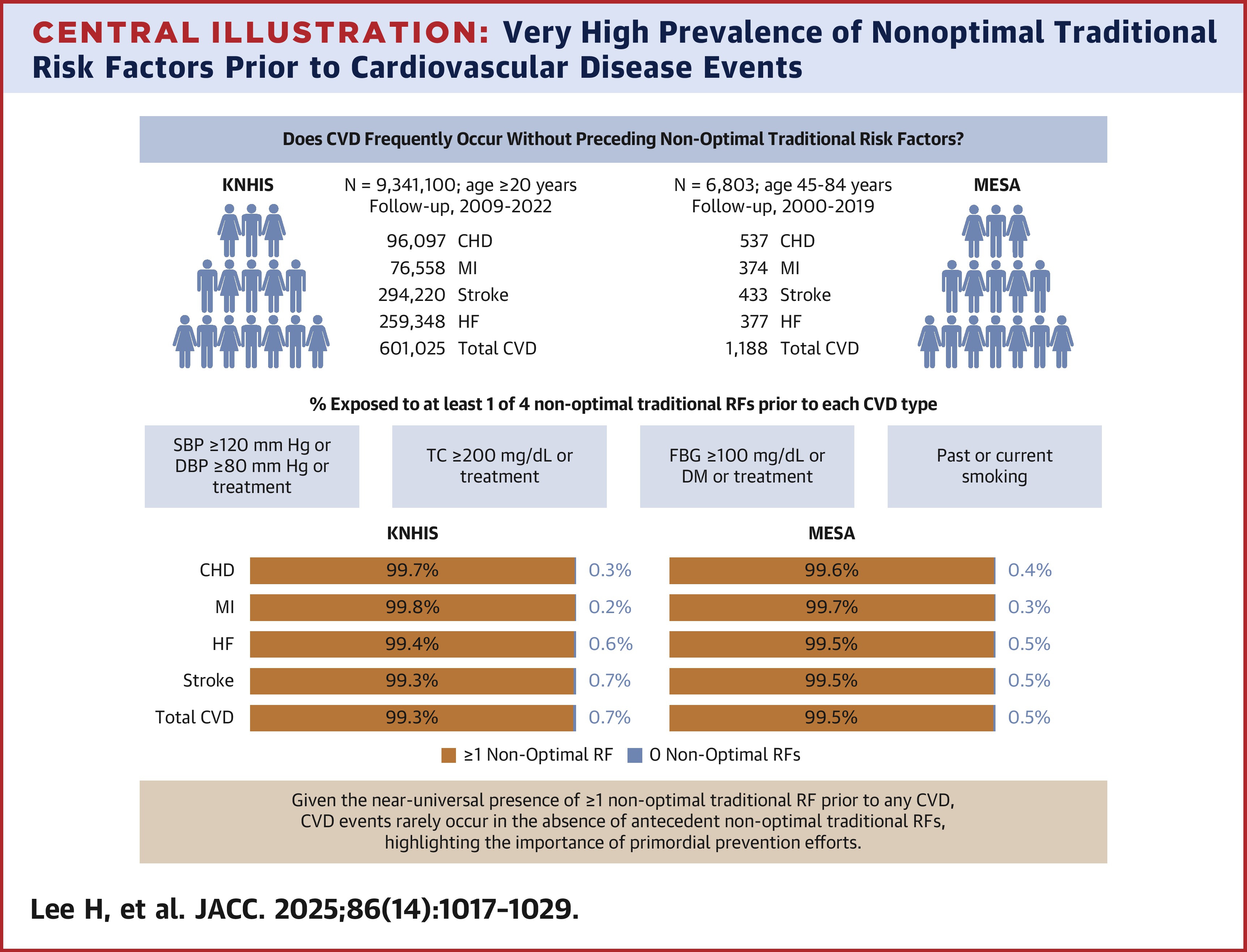
Findings also revealed that across age groups in both sexes, there was a consistently high prevalence (>99%) of risk factors. Women aged <60 years had the lowest proportion, with >95% risk factors observed for HF and stroke. Prevalence of two or more risk factors preceding cardiovascular events was also high (93.2%-97.2%).
Notably, elevated BP was the most prevalent nonoptimal risk factor (95.6%-96.1% in KNHIS; 93.0%-96.8% in MESA), whereas past or current smoking was the least prevalent (47.9%-68.1% in KNHIS; 54.1%-63.3% in MESA).
In an accompanying editorial comment, Neha J. Pagidipati, MD, MPH, FACC, notes that individuals in both groups had a median of four visits before a cardiovascular event, "indicating multiple opportunities for risk factor assessment." The study "emphasizes that we can – and must – do better to recognize and treat risk before it manifests as cardiac events," concludes Pagidipati.
Clinical Topics: Dyslipidemia, Heart Failure and Cardiomyopathies, Atherosclerotic Disease (CAD/PAD), Lipid Metabolism, Nonstatins, Acute Heart Failure
Keywords: Heart Disease Risk Factors, Heart Failure, Cholesterol, Diabetes Mellitus, Tobacco Use, Stroke, Coronary Artery Disease, Myocardial Infarction, Blood Pressure, Atherosclerosis
< Back to Listings


