Elevated TMPG After Mitral TEER Associated With Worse Outcomes, Regardless of MR Severity
Elevated transmitral mean pressure gradient (TMPG) was associated with greater risk of all-cause death and heart failure (HF) hospitalization among patients with functional mitral regurgitation (MR) after mitral transcatheter edge-to-edge repair (TEER), according to a study published Nov. 3 in JACC.
Hiroshi Tsunamoto, MD, et al., conducted a multivariable analysis investigating the impact of residual MR and TMPG elevation in 2,360 functional MR patients who underwent mitral TEER. Five patient groups were defined to help determine the prognostic impact of these two factors: MR ≤ mild and TMPG <5 mm Hg; MR ≤ mild and TMPG ≥5 to 10 mm Hg; moderate MR and TMPG <5 mm Hg; moderate MR and TMPG ≥5 to 10 mm Hg; and MR > moderate or TMPG 10 mm Hg.
All-cause death or HF hospitalization was the study's primary endpoint, which progressively increased with higher TMPG – from 25% at 1 mm Hg to 47% at 6 mm Hg – at the two-year mark. Risk of all-cause death or HF hospitalization was independently associated with TMPG per 1 mm Hg increase (hazard ratio, 1.10; 95% CI, 1.02-1.17; p=0.008).
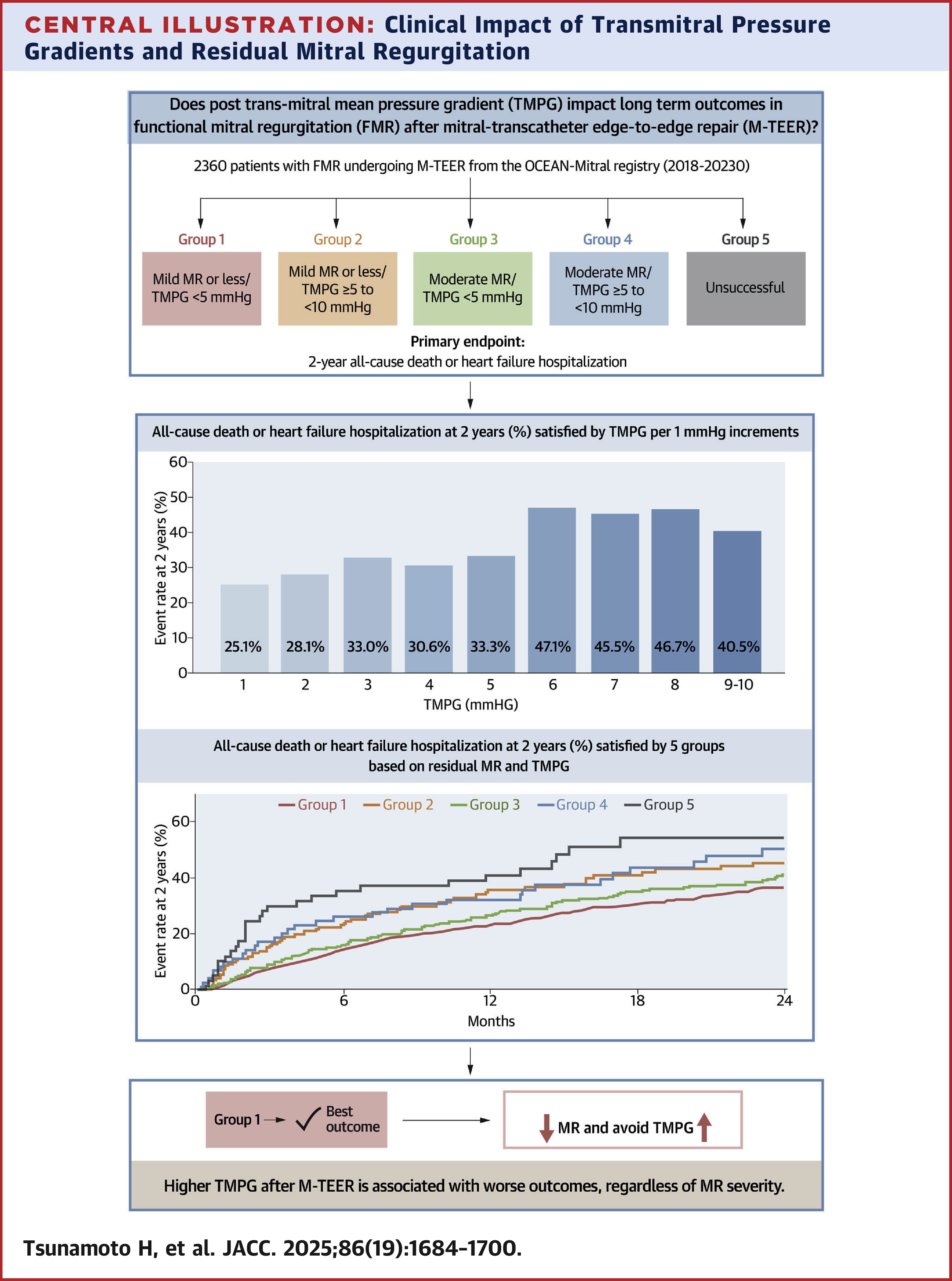
Moderate MR was not associated with a higher risk of the primary endpoint when compared to MR ≤ mild; however, MR > moderate was a significant predictor of these poor outcomes. Overall, patients in the group with MR ≤ mild and TMPG <5 mm Hg exhibited the lowest rate of the primary endpoint. The incidence rates were 28%, 39%, 33%, 44% and 48%, respectively (p<0.001).
"Stratification by residual MR severity and TMPG suggested that prognosis appeared similar between ≤ mild and moderate residual MR when TMPG remained low," note the authors. "These findings indicate that considering both MR reduction and TMPG management as a potential dual target could serve as a useful marker for risk stratification."
In an accompanying editorial comment, Tarun Chakravarty, MD, et al., add that "TEER effectiveness in [functional MR] should be assessed by both MR reduction and mitral valve gradients, navigating the fine line between aggressive MR reduction and the hemodynamic penalty of mitral stenosis."
Clinical Topics: Heart Failure and Cardiomyopathies, Valvular Heart Disease, Acute Heart Failure, Mitral Regurgitation
Keywords: Mitral Valve Insufficiency, Mitral Valve, Risk Assessment, Hemodynamics, Heart Failure
< Back to Listings


