Patients With Prior GIB Undergoing LAAO More Likely to Suffer Future Bleeding | NCDR Study
Patients with prior gastrointestinal bleeding (GIB) undergoing left atrial appendage occlusion (LAAO) were more likely to experience in-hospital complications and long-term GIB and major bleeding, according to a study recently published in JACC: Clinical Electrophysiology.
Douglas Darden, MD, FACC, et al., used data from the ACC's LAAO Registry, including 250,779 patients (33.7% had prior GIB) who underwent LAAO between January 2016 and December 2022. They compared in-hospital and long-term adverse events, mortality and post implantation antithrombotic prescriptions among patients with vs. without prior GIB.
Results identified an association between prior GIB and greater risk of in-hospital complications (odds ratio, 1.18; 95% CI, 1.10-1.26), GIB at 45 days (hazard ratio [HR], 4.36; 95% CI, 4.07-4.66) and major bleeding at 45 days (HR, 2.94; 95% CI, 2.74-3.16). These risks persisted at one-year post procedure for both GIB (HR, 3.84; 95% CI, 3.65-4.03) and major bleeding (HR, 2.82; 95% CI, 2.67-2.98). Prior GIB was also associated with a significantly higher risk of mortality at one year (HR, 1.10; 95% CI, 1.06-1.14). Both groups exhibited similar risk of stroke.
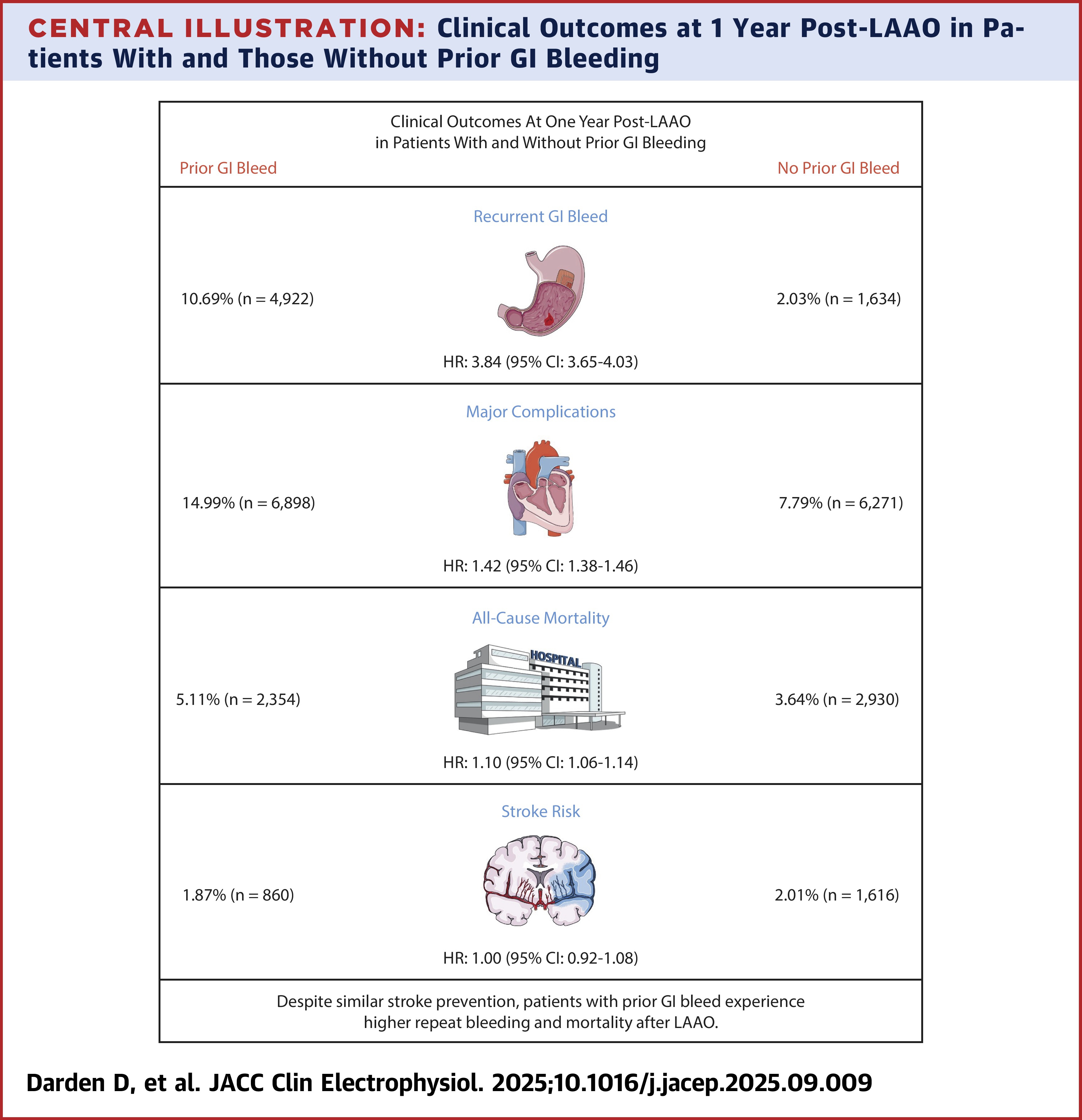
The authors also found that patients with prior GIB were more likely to be prescribed conservative antithrombotic regimens post LAAO. The prior GIB group had higher rates of no antithrombotic agents, warfarin only, and dual antiplatelet therapy.
"These findings highlight the importance of optimizing bleeding prevention strategies in high-risk patients," note the authors. "Comprehensive gastrointestinal evaluation before implantation, including endoscopic and laboratory assessments, may mitigate the risk for rebleeding during antithrombotic therapy."
Keywords: National Cardiovascular Data Registries, LAAO Registry, Gastrointestinal Hemorrhage, Atrial Appendage
< Back to Listings


