ACC Program Directors Survey: Are PDs Confident in Assessing Fellow Competence?
Direct engagement by teaching faculty is crucial in assessing fellows and program directors (PDs) remain confident in assessing fellow competency and they are reluctant about moving towards purely competency-based medical education, according to results from the fifth iteration of ACC's Cardiovascular Program Director Survey, published Dec. 19, 2025, in JACC: Advances.
Members of ACC's Program Directors and Graduate Medical Educators Member Section distributed a 15-question survey to 268 eligible programs from May 11, 2022, through July 1, 2022. Programs were identified through the Accreditation Council for Graduate Medical Education's (ACGME) online database and the survey was emailed to PDs. Survey items focused on competency development, trainee evaluation and assessment in cardiology fellowship.
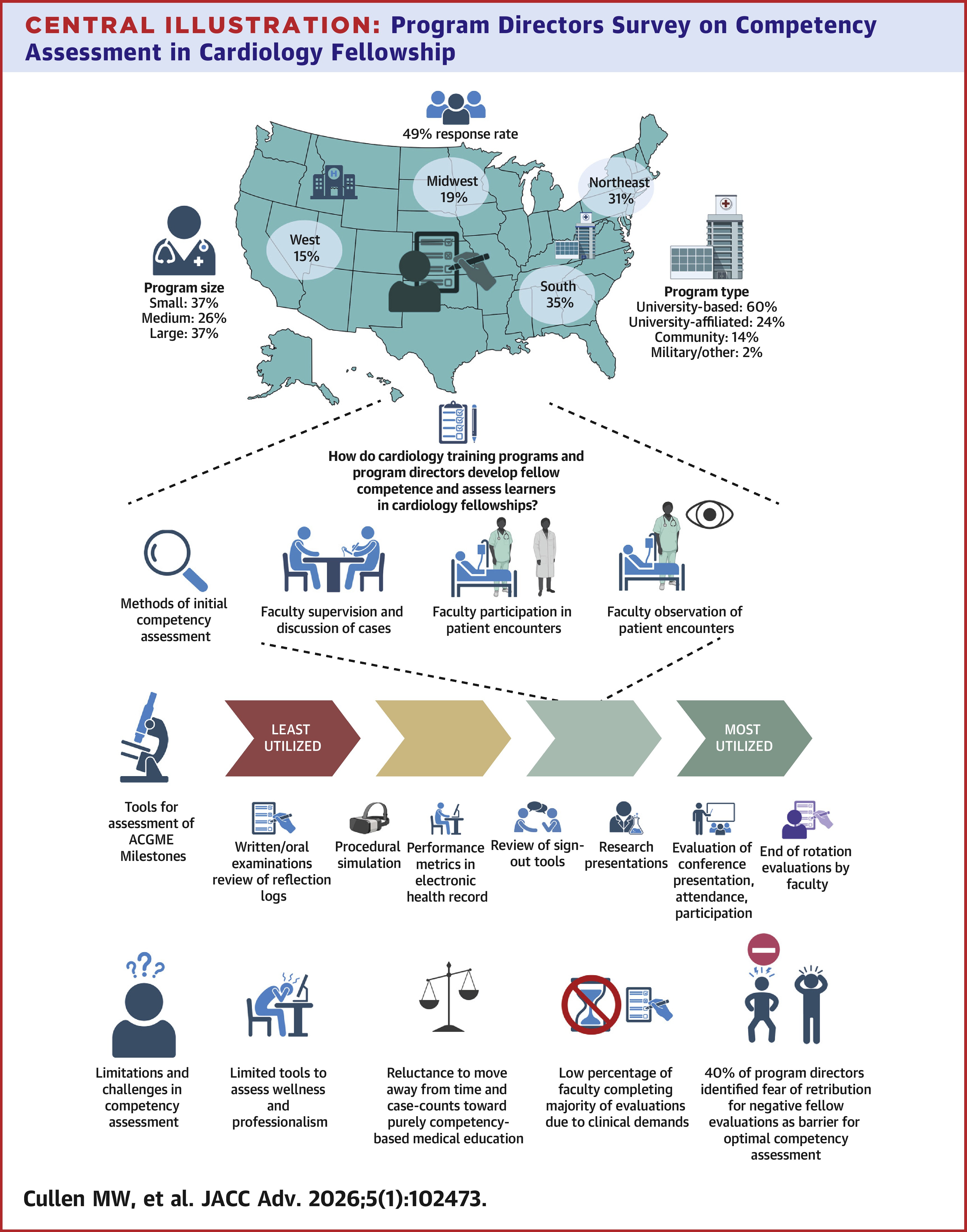
Of the 49% of PDs who responded to the survey, most represented university-based programs (60%). Discussion of cases and direct faculty supervision (90%) was the most common way to assess fellow competence at the start of training. Additionally, the most common tool to assess five of six ACGME Core Competencies was faculty evaluation. To assess medical knowledge competency, 93% of respondents used ACC's In-Training Examination.
Only 60% of faculty complete the majority of fellow evaluations; despite challenges, 81% of PDs reported feeling confident in their assessment abilities. Most (90%) of the responding PDs viewed fellows as competent after they met the time- and case-counts set in the Core Cardiovascular Training Statement (COCATS) 4. Only a small proportion (39%) were prepared to move away from this evaluation method.
"Our survey demonstrates that, despite many limitations, cardiology fellowship PDs feel confident in their ability to assess the competence of their fellows," write Michael W. Cullen, MD, FACC, et al."...direct observation and engagement from faculty represents a critical piece in the assessment of fellow competency. However, faculty inconsistently document fellow evaluations and may benefit from incentive structures to encourage fellow evaluation." Thus, they suggest that "cardiology fellowship programs should prioritize faculty development to improve direct observation skills of cardiologists who hold teaching roles."
Keywords: Education, Medical, Graduate, Education, Medical, Surveys and Questionnaires, Accreditation, Faculty
< Back to Listings


