
ORBITA-2 Secondary Analysis: PCI May Lead to Greater Symptom Relief in Older Adults
Age had no effect on PCI success in reducing angina frequency, but older adults may experience greater symptom relief, according to a post-hoc of the ORBITA-2 trial published Jan. 27 in JACC.
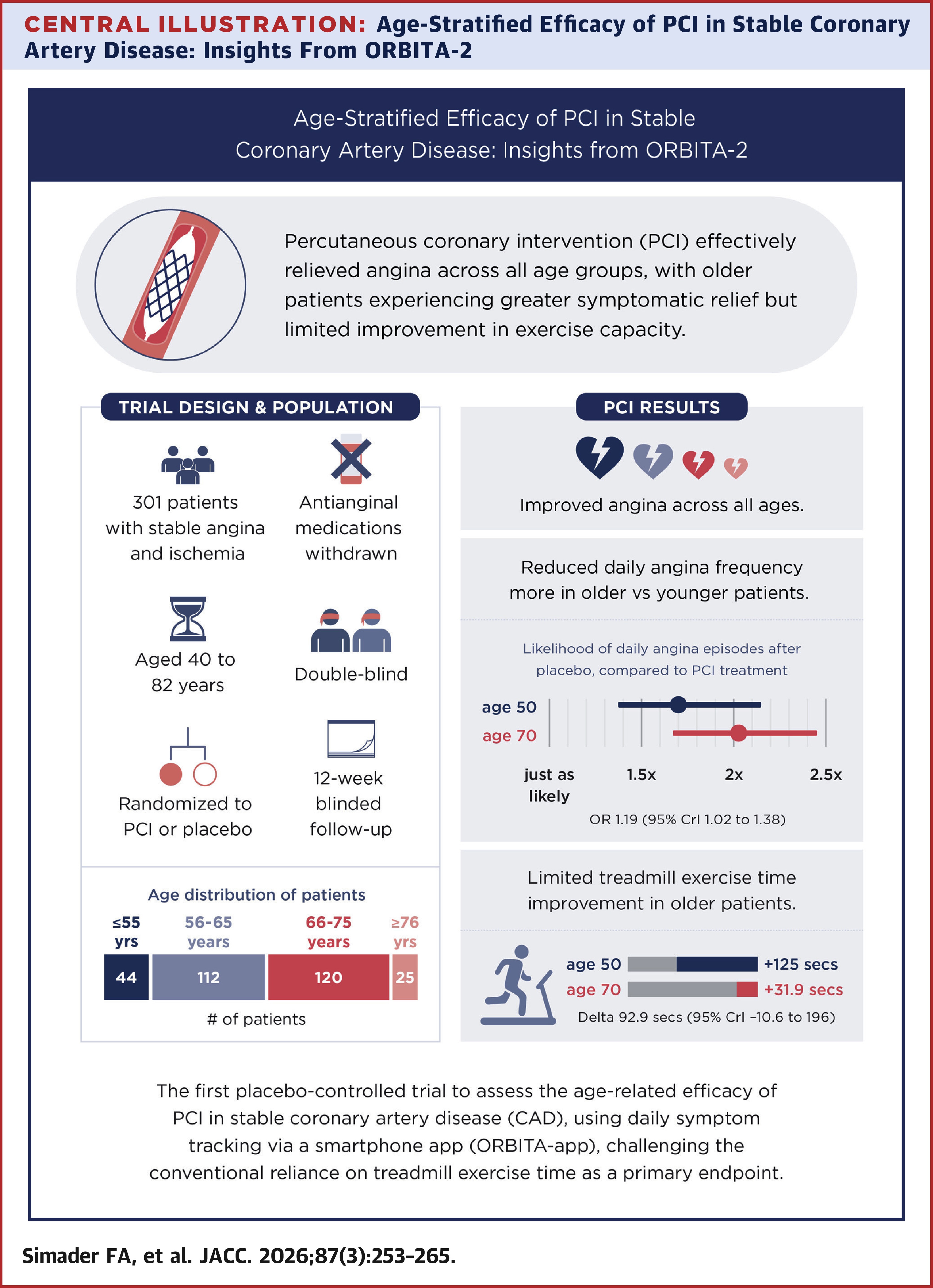
In the double-blind trial, 301 patients aged 40-82 (mean age, 64 years; 44 patients ≤55 years; 112 patients, 56-65 years; 120 patients, 66-75 years; 25 patients ≥76 years) were randomized to either PCI or placebo procedure. The trial evaluated whether PCI reduced angina symptoms in patients with stable coronary artery disease in the absence of anti-anginal medications and reported lower angina scores, lower daily angina frequency and improved treadmill time in PCI vs. placebo.
Results of this secondary analysis showed that baseline angina symptom severity or stenosis severity did not change among age groups. While PCI greatly improved angina across all ages, it was more effective for symptom relief in older patients (odds ratio [OR], 2.03; pr>0.99) than younger patients (OR, 1.70; pr>0.99; print, 0.99).
However, the effect of PCI on treadmill exercise time was greater in younger patients than older, with a 50-year-old seeing an improvement of 125 seconds (pr>0.99) compared to a 70-year-old seeing an improvement of only 32 seconds (pr>0.92; print, 0.96). Based on these findings, the authors question whether treadmill time is a useful or appropriate universal endpoint in future trials.
"For symptom improvement, the results challenge the notion that PCI should be withheld based solely on age," study authors Florentina A. Simader, MD, et al., write on their findings. "Importantly, symptom and quality of life improvement are desirable to patients at any age."
In an accompanying editorial comment, Michael G. Nanna, MD, FACC; Zafer Akman, MD; and Abdulla A. Damluji, MD, PhD, FACC; write that "one of cardiology's enduring questions is how, and how much, age should influence clinical decision-making."
"Although age has long served as a marker of risk in cardiovascular care, these data reinforce the idea that chronological age alone should not be the gatekeeper to symptom-relieving therapies," they add. "Age does not negate the potential for benefit; it reframes how we interpret that benefit and what it means in the broader context of a patient's life."
Clinical Topics: Invasive Cardiovascular Angiography and Intervention, Stable Ischemic Heart Disease, Atherosclerotic Disease (CAD/PAD), Interventions and Coronary Artery Disease, Chronic Angina
Keywords: Percutaneous Coronary Intervention, Angina, Stable, Coronary Artery Disease
< Back to Listings


