Cardiomyopathy Gene Variants Increase Risk of AFib
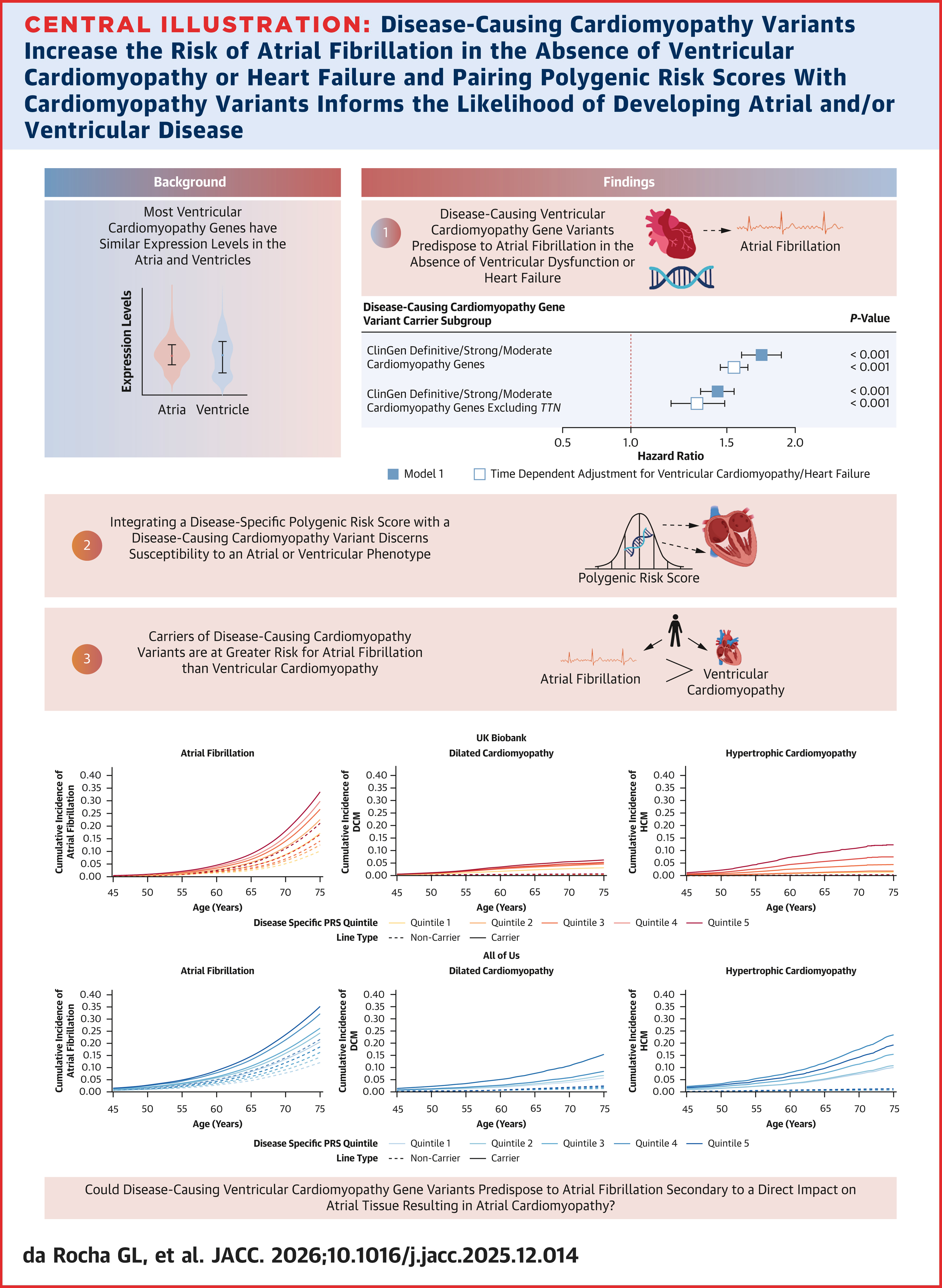
The genetic variants that cause cardiomyopathy also increase the risk of atrial fibrillation (AFib), even in individuals without heart failure (HF) or overt ventricular disease, according to research published Feb. 18 in JACC. Furthermore, the addition of disease-specific polygenic risk scores (PRS) improved the ability to discern the risk of AFib, dilated cardiomyopathy (DCM) and hypertrophic cardiomyopathy (HCM) in carriers.
In a pooled meta-analysis, study authors Guilherme L. da Rocha, MD, et al., focused on 29 ClinGen-validated genes for DCM, HCM and arrhythmogenic right ventricular cardiomyopathy (ARVC) in 655,796 adults from the UK Biobank (UKB; n=364,714) and the All of Us (AoU; n=291,082) cohort studies, identifying 9,410 carriers. Participants were stratified into quintiles using the PRS for AFib (PRSAF), DCM (PRSDCM) and HCM (PRSHCM).
Results showed that the presence of a disease-causing variant was associated with an increased risk of AFib (hazard ratio [HR] 1.73; p<0.001), including after adjustment for incident ventricular cardiomyopathy or clinical HF (adjusted HR 1.55; p<0.001), suggesting a direct atrial effect.
Increasing PRSAF, PRSDCM and PRSHCM quintiles were associated with increased risk of AFib, DCM and HCM, respectively, and the presence of a disease-causing rare variant further increased the magnitude.
In carriers in the highest PRSAF quintile, compared with noncarriers in the lowest quintile, the risk of developing AFib by age 75 in the UKB and AoU cohorts, respectively were 32.5% and 32.4% vs. 9.8% vs. 11.0%. The absolute cumulative cardiomyopathy risk for carriers in the top quintile ranged from 5.9% (UKB) to 15.2% (AoU) for DCM and 11.7% (UKB) to 19.1% (AoU) for HCM.
"Despite these genes having been originally identified as culprits for ventricular cardiomyopathy, their impact on the absolute risk and risk increase for [AFib] appears comparable and often larger relative to those for developing HCM and DCM within the general population," the authors write.
"Based on the findings of this study, [AFib] should be viewed as a clinically relevant and potentially early manifestation of inherited myocardial disease rather than solely as a downstream consequence of ventricular dysfunction," add Aniruddh P. Patel, MD; Elizabeth Silver, MD; and Si-Die Demeester, BS; in an accompanying editorial comment. "Future studies should define the natural history of atrial and ventricular disease across common and rare variant risk strata, clarify the timeline of [AFib] and HF development, and determine whether genotype-informed prevention and surveillance can meaningfully reduce [AFib]-related morbidity."
Clinical Topics: Arrhythmias and Clinical EP, Heart Failure and Cardiomyopathies, Atrial Fibrillation/Supraventricular Arrhythmias
Keywords: Cardiomyopathy, Dilated, Cardiomyopathy, Hypertrophic, Atrial Fibrillation
< Back to Listings


