Is Progression of Myocardial Fibrosis a Risk Indicator in HCM?
Myocardial fibrosis increased over time in patients with hypertrophic cardiomyopathy (HCM), as assessed by late gadolinium enhancement (LGE) on follow-up cardiac MR, suggesting a higher risk for adverse outcomes, including all-cause mortality, hospitalization and stroke, according to research published Feb. 20 in JACC: Cardiovascular Imaging.
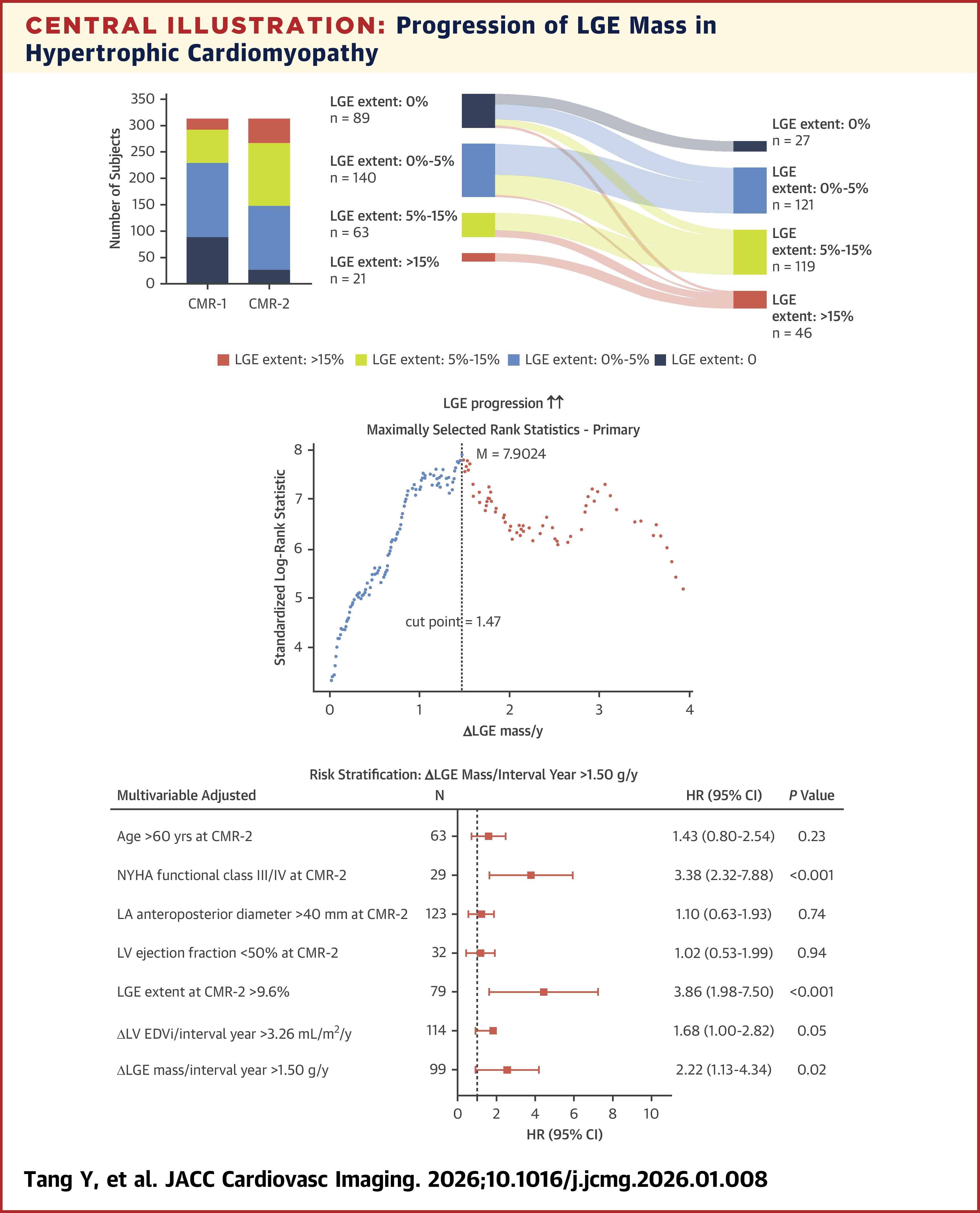
Study authors Yun Tang, MD, et al., retrospectively analyzed data from 313 patients with HCM (31% women) who had two cardiac MR scans (median interval 4.2 years) and evaluated the change in LGE mass per year (ΔLGE mass/y). LGE was defined as signal intensity ≥6 SDs above that of remote normal myocardium within the same slice.
Results showed that LGE mass progressed from a median of 2.9 g to 8.3 g from the first CMR to the second CMR. Additionally, significant differences were seen in left atrial anteroposterior diameter (36.6 mm vs. 38.6 mm), LVEF (64.5% vs. 61.2%), left ventricular end-diastolic volume index (67.1 mL/m2 vs. 77.8 mL/m2) and LV end-systolic volume index (25.0 mL/m2 vs. 32.0 mL/m2).
Of the 89 patients without LGE on their first scan, 70% had fibrosis present on the second scan. The proportion of patients with extensive LGE (≥15%) increased from 7% to 15%.
Over the median 3.4-year follow-up after the second cardiac MR scan, 69 patients experienced a primary endpoint event (all-cause mortality, heart transplantation, aborted sudden cardiac death, unscheduled hospitalization for heart failure, stroke); 17 of whom reached the secondary endpoint of all-cause mortality, aborted sudden cardiac death and heart transplantation.
Rapid ΔLGE mass/y was shown to be an independent factor significantly associated with increased risk for a primary and a secondary outcome, with optimal cutoffs of >1.50 (hazard ratio, 2.22) and >3.75, respectively. Moreover, adding the parameter to the baseline model improved discrimination and risk classification.
Study results were validated against an external cohort of 69 patients.
"Our results support the hypothesis that ΔLGE mass/y could be used as a prognostic marker to identify high-risk patients with HCM," write Tang, et al., noting their research "provides effective evidence to support the current AHA/ACC guideline recommendation of enhanced CMR as a routine monitoring method" in this population.
Clinical Topics: Arrhythmias and Clinical EP, Heart Failure and Cardiomyopathies, SCD/Ventricular Arrhythmias, Acute Heart Failure
Keywords: Magnetic Resonance Spectroscopy, Death, Sudden, Cardiac, Cardiomyopathy, Hypertrophic, Heart Failure, Gadolinium, Fibrosis
< Back to Listings


