Clinical Practice Algorithm For the Follow-Up of Repaired and Unrepaired Atrioventricular Septal Defects
Quick Takes
- Timing of surgical referral for pediatric atrioventricular septal defect (AVSD) depends on the subtype of AVSD, with repair in infancy for complete and intermediate AVSD and repair during the toddler years for partial/transitional AVSD.
- Left atrioventricular valve insufficiency and development of left ventricular outflow tract obstruction are the most common postoperative complications that may warrant frequent follow-up and potential reintervention.
- Older children and adults with unrepaired AVSD may require diagnostic cardiac catheterization before surgical intervention, with additional management decisions guided by hemodynamic findings.
Background
Atrioventricular septal defects (AVSDs) represent a spectrum of congenital heart lesions that result from abnormal embryologic development of the endocardial cushions in the primitive atrioventricular (AV) canal. Primum atrial septal defects (ASDs), inlet ventricular septal defects (VSDs), and abnormalities of the AV valve are among the possible pathologic features of AVSD. AVSD can be subclassified on the basis of the anatomy of the AV valve and the degree of shunting at the ventricular level. Complete AVSD describes both an inlet VSD and a primum ASD, accompanied by an AV valve with a common annulus. An intermediate AVSD, despite being a variant of a complete AVSD, has a distinct right and left AV valve orifice with a common annulus and a large inlet VSD. In a transitional AVSD, the VSD is typically small and restricted by chordal attachments to the ventricular septum. Lastly, partial AVSD has a separate right and left AV valve annulus with a cleft in the left AV valve accompanied by a primum ASD.1 Clinical presentation and management vary on the basis of these anatomical features. There remains a lack of evidence-based guidelines for optimal frequency of follow-up and testing in patients with AVSD, either before or following surgical intervention, leading to wide variation in clinical practice and resource utilization.
Goals and Details of the Algorithm
The goal of the unrepaired and repaired AVSD clinical practice algorithm is to provide cardiologists and other health care providers with a decision-support tool for clinical evaluation and follow-up testing of AVSDs (Figures 1a, b). This guidance is not meant to replace health care providers' clinical judgment but rather to improve the value of care by reducing practice variation and optimizing resource utilization.
Figure 1a: Outpatient Management of Unrepaired Isolated AVSD
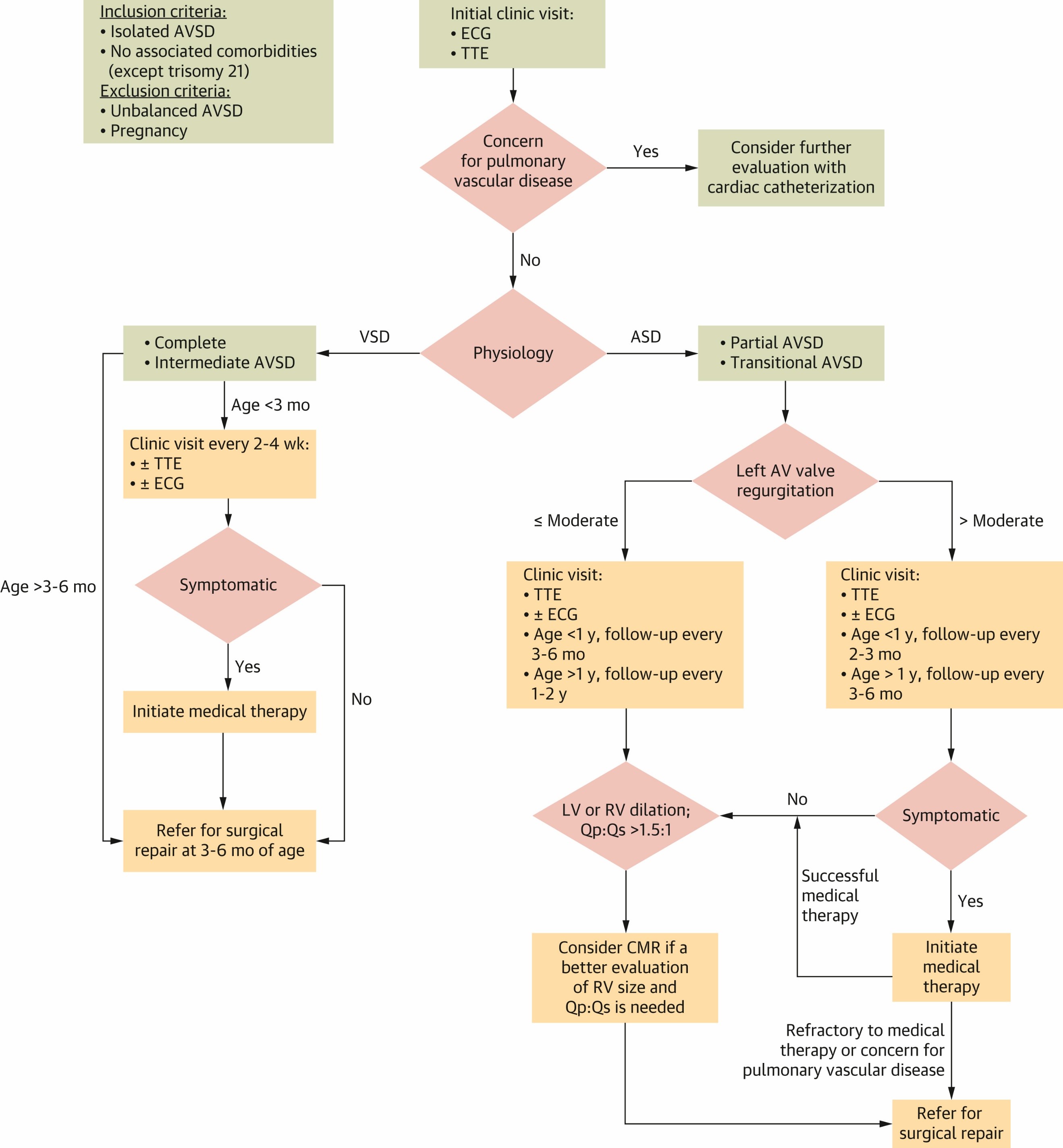
Reprinted with permission from Writing Committee, Sachdeva R, Parthiban A, et al. Outpatient management of isolated left-to-right shunt lesions in pediatric patients: 2026 ACC concise clinical guidance: a report of the American College of Cardiology Solution Set Oversight Committee. J Am Coll Cardiol. Published online March 26, 2026. doi:10.1016/j.jacc.2025.11.020
ASD = atrial septal defect; AV = atrioventricular; AVSD = atrioventricular septal defect; CMR = cardiovascular magnetic resonance; ECG = electrocardiogram; LV = left ventricle; Qp:Qs = ratio of pulmonary blood flow to system blood flow; RV = right ventricle; TTE = transthoracic echocardiography; VSD = ventricular septal defect.
Figure 1b: Outpatient Management of Repaired AVSD
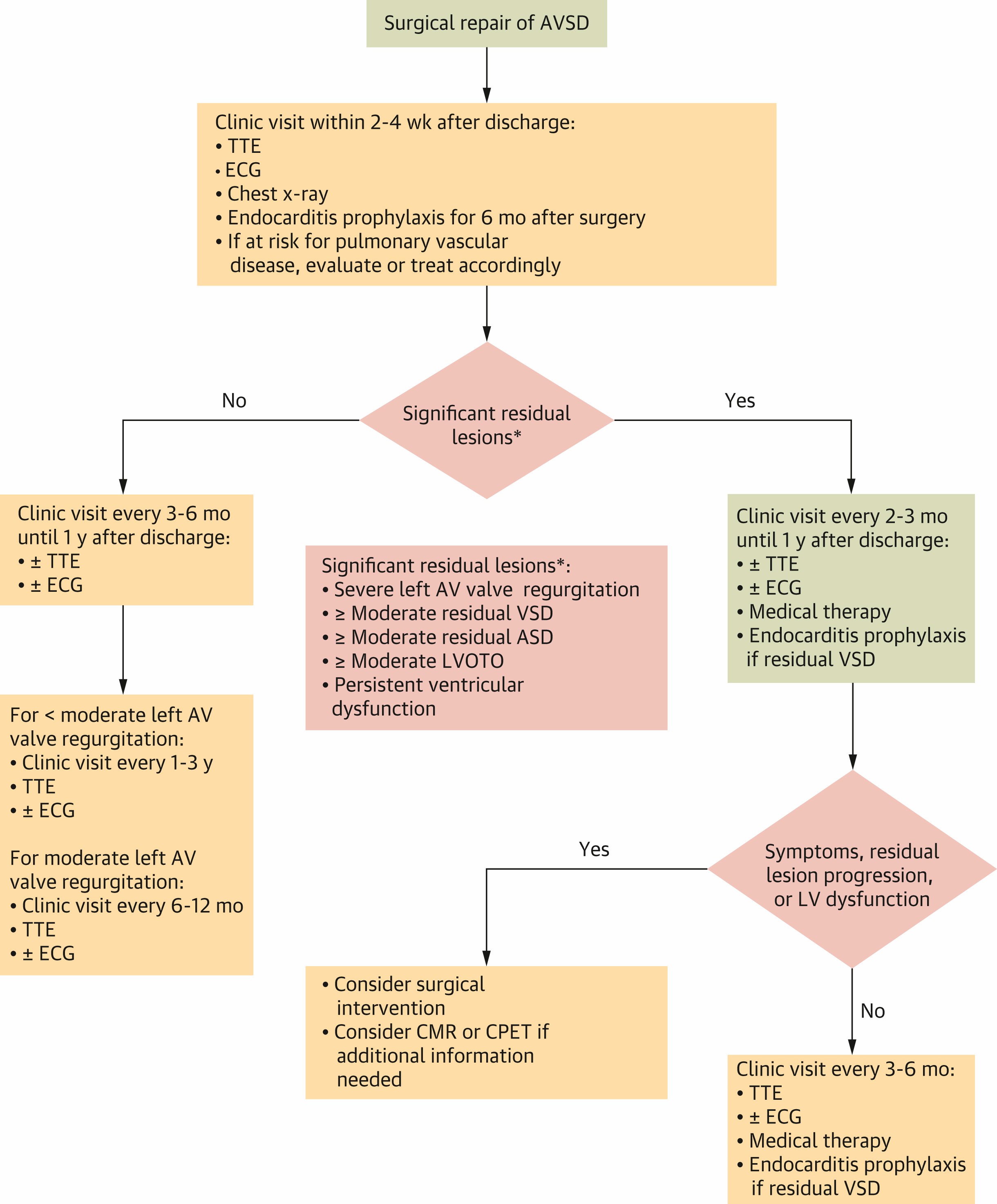
Reprinted with permission from Writing Committee, Sachdeva R, Parthiban A, et al. Outpatient management of isolated left-to-right shunt lesions in pediatric patients: 2026 ACC concise clinical guidance: a report of the American College of Cardiology Solution Set Oversight Committee. J Am Coll Cardiol. Published online March 26, 2026. doi:10.1016/j.jacc.2025.11.020
*Significant residual lesions include severe left AV valve regurgitation, at least moderate residual VSD, at least moderate residual ASD, greater-than-moderate LVOTO, or persistent ventricular dysfunction.
ASD = atrial septal defect; AV = atrioventricular; AVSD = atrioventricular septal defect; CMR = cardiovascular magnetic resonance; CPET = cardiopulmonary exercise testing; ECG = electrocardiogram; LV = left ventricle; LVOTO = left ventricular outflow tract obstruction; TTE = transthoracic echocardiography; VSD = ventricular septal defect.
The algorithm was developed for unrepaired and repaired AVSD in patients <18 years of age. Patients were excluded if any of the following were present: additional cardiac defects, unbalanced AVSD, extracardiac comorbidities, genetic syndromes other than trisomy 21, and pregnancy. The management algorithm was based on whether the patient has primary ASD or VSD physiology. Subtypes of AVSD with hemodynamically significant (i.e., complete and intermediate) VSDs result in higher likelihood of symptoms, need for earlier surgical repair than in patients without a VSD, and need for assessment of pulmonary arterial hypertension in older children who have not undergone repair. The degree of AV valve regurgitation also influenced recommendations for frequency and timing of follow-up care. Medical management with diuretics, afterload reduction, and nutritional support may be required, particularly in the setting of hemodynamically significant VSD or significant left AV valve regurgitation. Patients with partial and transitional AVSDs in the absence of significant left AV valve regurgitation are less likely to experience symptoms, and follow-up can be less frequent than in those with a hemodynamically significant VSD. AVSD nearly always requires surgical repair, with the timing of repair determined by the specific anatomical type of AVSD and associated physiology. For patients with a significant ventricular-level shunt, surgical repair is typically performed in the first 3-6 months of life, with optimal timing based on the ability to medically manage symptoms of pulmonary overcirculation and maintain adequate growth. Earlier surgical repair has been associated with worse outcomes.2 In those with primarily ASD physiology, surgical repair is typically performed later, with optimal timing in the toddler years.3 For all patients, long-term surveillance for residual lesions is required and reintervention may be required in as many as 10-25% of patients, with the most common indications for reintervention being residual left AV valve regurgitation and left ventricular outflow tract obstruction.4
(For management of unrepaired AVSDs in patients >18 years of age, refer to the 2025 ACC/AHA/Multisociety Guideline for the Management of Adults With Congenital Heart Disease.5)
Methods: Algorithm Development
The unrepaired and repaired AVSD clinical practice algorithm was developed by the Quality Working Group of the American College of Cardiology (ACC) Adult Congenital and Pediatric Cardiology (ACPC) member section. This algorithm was developed in a manner similar to the secundum ASD algorithm using the existing guidelines and the 2026 ACC concise clinical guidance on Outpatient Management of Isolated Left-To-Right Shunt Lesions in Pediatric Patients.6-9
Future Directions
The unrepaired and repaired AVSD clinical practice algorithm can be integrated by clinicians as a decision-support tool in their practices. Furthermore, centers can use them for quality-improvement initiatives. The widespread use and implementation of the AVSD algorithm could improve resource utilization and standardize the care of patients with isolated AVSDs.
References
- Shaddy RE, Penny DJ, Feltes TF, Cetta F, Mital S, eds. Moss and Adams' Heart Disease in Infants, Children, and Adolescents: Including the Fetus and Young Adult. 10th ed. Vol. 1. Wolters Kluwer; 2021.
- Mery CM, Zea-Vera R, Chacon-Portillo MA, et al. Contemporary results after repair of partial and transitional atrioventricular septal defects. J Thorac Cardiovasc Surg. 2019;157(3):1117-1127.e4. doi:10.1016/j.jtcvs.2018.10.154
- Minich LL, Atz AM, Colan SD, et al. Partial and transitional atrioventricular septal defect outcomes. Ann Thorac Surg. 2010;89(2):530-536. doi:10.1016/j.athoracsur.2009.10.047
- Fong LS, Betts K, Ayer J, et al. Predictors of reoperation and mortality after complete atrioventricular septal defect repair. Eur J Cardiothorac Surg. 2021;61(1):45-53. doi:10.1093/ejcts/ezab221
- Gurvitz M, Krieger EV, Fuller S, et al. 2025 ACC/AHA/HRS/ISACHD/SCAI guideline for the management of adults with congenital heart disease: a report of the American College of Cardiology/American Heart Association Joint Committee on Clinical Practice Guidelines. J Am Coll Cardiol. 2026;87(7):822-976. doi:10.1016/j.jacc.2025.09.006
- Sachdeva R, Parthiban A, Birnbaum B, et al. Clinical Practice Algorithm For the Follow-up of Unrepaired and Repaired Secundum Atrial Septal Defects. 2026. Available at: https://www.acc.org/Latest-in-Cardiology/Articles/2022/03/08/19/34/ Clinical-Practice-Algorithm-For-the-Follow-up-of-Unrepaired-and-Repaired-SASD. Accessed 08/2026.
- Sachdeva R, Valente AM, Armstrong AK, et al. ACC/AHA/ASE/HRS/ISACHD/SCAI/SCCT/SCMR/SOPE 2020 appropriate use criteria for multimodality imaging during the follow-up care of patients with congenital heart disease: a report of the American College of Cardiology Solution Set Oversight Committee and Appropriate Use Criteria Task Force, American Heart Association, American Society of Echocardiography, Heart Rhythm Society, International Society for Adult Congenital Heart Disease, Society for Cardiovascular Angiography and Interventions, Society of Cardiovascular Computed Tomography, Society for Cardiovascular Magnetic Resonance, and Society of Pediatric Echocardiography. J Am Coll Cardiol. 2020;75(6):657-703. doi:10.1016/j.jacc.2019.10.002
- Writing Committee Members, Otto CM, Nishimura RA, et al. 2020 ACC/AHA guideline for the management of patients with valvular heart disease: a report of the American College of Cardiology/American Heart Association Joint Committee on Clinical Practice Guidelines. J Am Coll Cardiol. 2021;77(4):e25-e197. doi:10.1016/j.jacc.2020.11.018
- Writing Committee, Sachdeva R, Parthiban A, et al. Outpatient management of isolated left-to-right shunt lesions in pediatric patients: 2026 ACC concise clinical guidance: a report of the American College of Cardiology Solution Set Oversight Committee. J Am Coll Cardiol. Published online March 26, 2026. doi:10.1016/j.jacc.2025.11.020
Clinical Topics: Cardiac Surgery, Cardiovascular Care Team, Congenital Heart Disease and Pediatric Cardiology, Cardiac Surgery and CHD and Pediatrics, Congenital Heart Disease, CHD and Pediatrics and Quality Improvement
Keywords: Heart Defects, Congenital, Heart Septal Defects, Ventricular, Heart Septal Defects, Pediatrics, Quality Improvement
