The Relationship Between Exercise and Longevity: Challenging the U-Shaped Hypothesis
Quick Takes
- Elite athletes and longevity: Evidence suggests that elite athletes generally live longer than the general population, with studies demonstrating lower mortality rates and reduced cardiovascular disease (CVD) and cancer risks among elite athletes.
- Sports-specific trends: Not all sports provide the same longevity benefits. Endurance-based activities like running appear to confer greater longevity compared with power sports such as boxing or weightlifting.
- Exercise volume and intensity: High volumes of physical activity (≥10,000 MET·min/week) are not associated with increased mortality risk, and intensity may play a more critical role in reducing CVD mortality than volume.
Introduction: The U-Shaped Hypothesis and Emerging Evidence
Based on epidemiologic studies, it has been posited that there is a U- or reverse J-shaped relationship between exercise and cardiovascular outcomes. The benefits of regular exercise on longevity are well described; however, for elite athletes that are engaging in extraordinary training volumes and intensity, the impact of such training on their longevity is not well understood. Recent studies suggest that elite athletes have increased longevity compared with the general population (Figure 1).
Figure 1: Elite athletes and longevity: challenging the U-shaped hypothesis
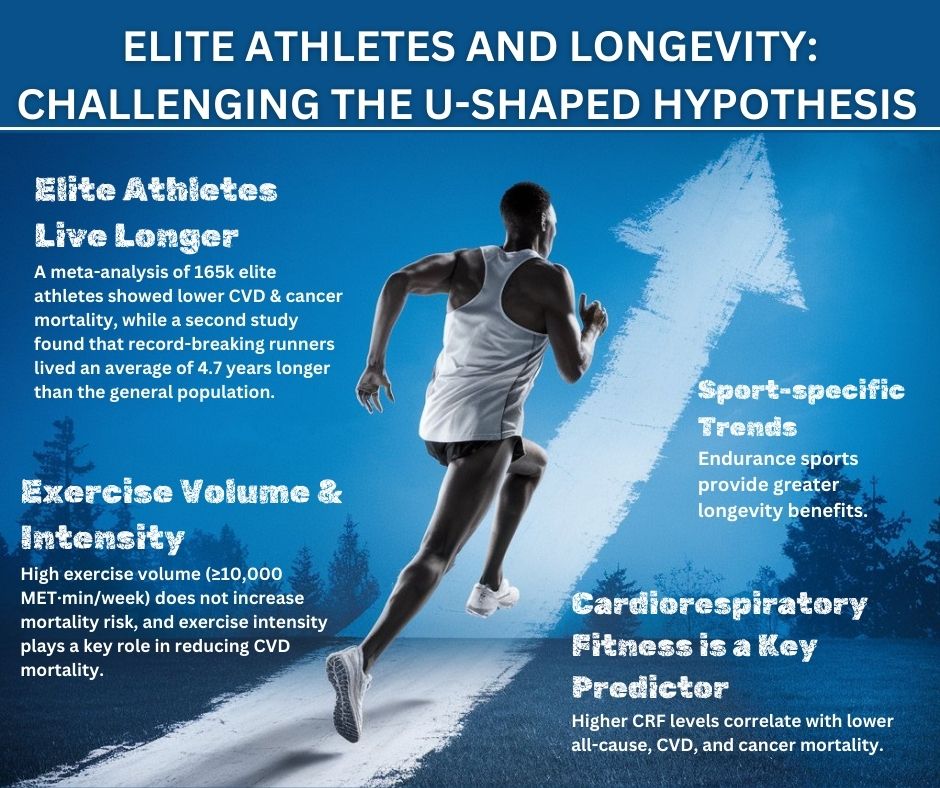
CRF = cardiorespiratory fitness; CVD = cardiovascular disease.
Elite Athletes Live Longer: Evidence From Record-Breaking Runners
A study by Foulkes et al. on the longevity of 200 sub-4-min-mile runners, a feat requiring high volumes of maximal effort and high-intensity training, demonstrated that these athletes lived, on average, 4.7 years longer than the general population (adjusted for age, sex, and nationality).1 Supporting this finding, a meta-analysis of 24 studies by Runacres et al. that included 165,033 former elite athletes (15.6% women) demonstrated that overall these athletes lived longer and had a reduced incidence of both cardiovascular disease (CVD) and cancer mortality compared with the general population (male standard mortality ratio, 0.69 [95% CI, 0.61-0.78]; female standard mortality ratio, 0.51 [95% CI, 0.40-0.65]; both p < 0.01).2
Sport-Specific Longevity Trends: Not All Sports Confer the Same Benefit
Although elite athletes generally have increased longevity, data suggest that not all sporting activities carry the same longevity benefit. In a subgroup analysis of the systematic review by Runacres et al., the mortality of male power athletes such as boxers, wrestlers, and weightlifters was not significantly different from the general population.2 Limited female data precluded this analysis. These findings suggest some sports, particularly endurance-based sports, may provide greater longevity benefits.
Data from the 55,137 relatively healthy individuals in the Aerobics Center Longitudinal Study support this notion. Lee et al. found that when stratified based on being active runners versus active in other physical activities, the active runners (inactive in other physical activity) had a 27% lower risk of death (hazard ratio, 0.73; 95% CI, 0.65-0.84) versus nonrunners who were active in other physical activity (active defined as >500 MET·min/week).3 The greatest benefit—a 43% lower mortality risk—was observed in runners also active in other physical activity compared with sedentary individuals inactive in both running and other forms of physical activity.3
Exercise Volume and Intensity Mediate Longevity: Insights From the Cooper Center Longitudinal Study
The Cooper Center Longitudinal Study enrolled 2,154 athletes free of CVD that reported physical activity ≥3000 MET·min/week to evaluate the belief that extreme exercise is harmful.4 The cohort was comprised of 28% women with mean age 52.1 years. Among those reporting extraordinary volume (≥10,000 MET·min/week, n = 66), there was no increase in all-cause mortality over 10 years of follow-up compared with those between 3000 and 10,000 MET·min/week.4 Of note, none of the extraordinary volume athletes died of CVD and only two died of any cause.4
Further supporting a longevity benefit at high volume of exercise is a systematic review and meta-analysis of 48 studies by Blond, et al., which demonstrated activity up to 6000 MET·min/week was not associated with a higher mortality risk compared with the recommended level of physical activity (~750 MET·min/week).5
Schwendinger et al. demonstrated that in a cohort of US adults, exercise intensity was the main driver of reduced CVD mortality risk compared with exercise volume.6 This observational study consisted of 7,518 participants (52.0% women; weighted median age, 49 years) enrolled in the 2011-2014 National Health and Nutrition Examination Survey with a median follow-up of 82 months, and was based on individual participant accelerometer data.6 Although not specific to elite athletes, these findings hint at the role of exercise intensity, not just volume, in mediating longevity.
Cardiorespiratory Fitness: A Possible Predictor of Longevity
Cardiorespiratory fitness (CRF) has demonstrated a dose-response relationship with longevity and CVD, with the highest fitness levels associated with greater longevity and lower incidence of CVD. In a cohort of 4,137 self-referred apparently healthy US adults (2,326 men, 1,811 women; mean age, 42.8 ± 12.2 years) followed for 24.2 ± 11.7 years (1.1-49.3 years) for mortality, Imboden et al. found that maximal oxygen uptake (VO2max) measured via cardiopulmonary exercise testing was inversely associated with risk for all-cause, CVD, and cancer mortality after adjusting for age, sex, examination year, and risk factors (p < 0.01).7
Those at the highest fitness levels (mean VO2max 49.8 ± 8.8 mL/kg/min in men and 35.9 ± 8.9 mL/kg/min in women) had the greatest longevity with each MET increment increase in CRF being associated with an 11.6%, 16.1%, and 14.0% reduction in all-cause, CVD, and cancer mortality, respectively.7 Although this trend suggests incremental increases in longevity based on increasing VO2max, the relationship between VO2max and longevity at higher levels of VO2max (elite athletes may have VO2max that exceeds 60 mL/kg/min) has not been well represented in the data.
Conclusion: Rethinking the Risks and Benefits of Extreme Exercise
As noted by Foulkes, et al., the overall cost-benefit of extreme exercise has been a concern for athletes, medical professionals, and the broader public at large, especially amidst findings of increased coronary calcification, atrial fibrillation, and myocardial fibrosis in elite athletes.1 Emerging data, however, challenge the prior belief that elite athletes are at increased risk of mortality, instead suggesting increased longevity at high volumes and intensities of athletic training.
Future studies are needed to further dissect the influence of lifetime physical activity patterns, health behaviors, CRF (VO2max), and the role of exercise volume versus intensity in longevity. Nonetheless, this growing body of data suggests that all exercise is beneficial and that elite athletes' high exercise dose and intensity are likely to contribute positively to increased longevity—though healthy lifestyle behaviors and physical activity across the lifespan remain paramount.
References
- Foulkes S, Hewitt D, Skow R, et al. Outrunning the grim reaper: longevity of the first 200 sub-4 min mile male runners. Br J Sports Med. 2024;58(13):717-721. Published 2024 Jun 20. doi:10.1136/bjsports-2024-108386
- Runacres A, Mackintosh KA, McNarry MA. Health consequences of an elite sporting career: long-term detriment or long-term gain? A meta-analysis of 165,000 former athletes. Sports Med. 2021;51(2):289-301. doi:10.1007/s40279-020-01379-5
- Lee DC, Brellenthin AG, Thompson PD, Sui X, Lee IM, Lavie CJ. Running as a key lifestyle medicine for longevity. Prog Cardiovasc Dis. 2017;60(1):45-55. doi:10.1016/j.pcad.2017.03.005
- DeFina LF, Wright BB, Willis BL, et al. Abstract 14863: Athletes performing extraordinary physical activity (>10,000 MET·min/week) at no greater risk of all-cause or cardiovascular disease mortality. Circulation. 2019;140(Suppl_1). doi/10.1161/circ.140.suppl_1.14863
- Blond K, Brinkløv CF, Ried-Larsen M, Crippa A, Grøntved A. Association of high amounts of physical activity with mortality risk: a systematic review and meta-analysis. Br J Sports Med. 2020;54(20):1195-1201. doi:10.1136/bjsports-2018-100393
- Schwendinger F, Infanger D, Lichtenstein E, et al. Intensity or volume: the role of physical activity in longevity. Eur J Prev Cardiol. 2025;32(1):10-19. doi:10.1093/eurjpc/zwae295
- Imboden MT, Harber MP, Whaley MH, Finch WH, Bishop DL, Kaminsky LA. Cardiorespiratory fitness and mortality in healthy men and women. J Am Coll Cardiol. 2018;72(19):2283-2292. doi:10.1016/j.jacc.2018.08.2166
Clinical Topics: Cardiovascular Care Team, Diabetes and Cardiometabolic Disease, Prevention, Sports and Exercise Cardiology, Exercise
Keywords: Cardiorespiratory Fitness, Longevity, Exercise
