Focus on Intervention | From Evidence to Action: Recent Trials Influencing Interventional Strategy
The wave of coronary and structural heart intervention trials from last year is shifting how interventional cardiologists may approach patient care. Across multiple domains including coronary devices, revascularization strategies, lesion preparation and structural therapies, new data are challenging long-standing assumptions and offering credible alternatives to established practice. While guidelines often lag behind the evidence, the implications of these trials should impact interventional strategies now.
DEBs Move Beyond Being Niche Tools
Drug-eluting balloons (DEBs) have taken center stage.1 More specifically, the results from the SELUTION DeNovo and SELUTION 4ISR trials have provided more evidence for their expanding role in treatment.2,3 SELUTION DeNovo showed that among patients with de novo coronary artery disease (CAD), sirolimus DEBs were noninferior to drug-eluting stents (DES) at one year for target vessel failure (TVF) (defined as a composite of cardiac death, target vessel-related myocardial infarction [MI], and clinically driven target vessel revascularization).2 SELUTION 4ISR extended this finding to patients with in-stent restenosis as sirolimus DEBs were shown to be noninferior to DES in terms of one-year TVF, while avoiding additional stent layers.3 There may be a future in which PCI can be performed without a permanent metallic implant with success rates in line with DES.
Rethinking PCI Strategy Post CABG
Optimal revascularization in patients with prior CABG has long been uncertain. Current guidelines recommend native vessel PCI rather than PCI of the bypass graft.1 However, there are limited observational data supporting this strategy. The PROCTOR trial directly addressed this gap by randomizing post-CABG patients to saphenous vein graft (SVG) PCI or native coronary PCI.4 Surprisingly, at one year, patients undergoing SVG PCI had a lower rate of major adverse cardiac events (MACE) than those undergoing native vessel PCI. MACE was driven mainly by PCI-related MI and repeat revascularization. This suggests that SVG PCI may be of benefit among post-CABG patients with a clinical indication for revascularization.
Ideal Timing of Nonculprit PCI
While complete revascularization in STEMI patients with multivessel CAD is now standard, the ideal timing for intervening on the nonculprit lesion is unsettled. In these patients, revascularization of nonculprit lesions at the time of culprit lesion revascularization may be preferable over staged approaches.1 However, evidence from iMODERN suggests that deferring revascularization of the nonculprit lesion may be equivalent to its immediate revascularization.5 In this comparison of immediate instantaneous wave-free ratio (iFR)-guided PCI of nonculprit lesions at the time of culprit lesion revascularization against staged cardiac stress MRI-guided PCI of nonculprit lesions, researchers found no significant differences in death, recurrent MI or heart failure hospitalization at three years between groups.5 This has practical implications: avoiding immediate nonculprit artery intervention should shorten procedure times and simplify acute STEMI care without compromising long-term outcomes.
New Tools For Severe Coronary Calcification
Intravascular lithotripsy (IVL) has been shown to be beneficial in patients with CAD plus severe coronary calcification.6 However, other tools are emerging, including cutting balloons and noncompliant balloons (NCBs). In Short-CUT, cutting ballons were noninferior to IVL in terms of stent expansion, minimal stent area and 30-day MACE events in calcified coronary lesions.7 In VICTORY, super-high-pressure NCBs were noninferior to IVL for stent expansion and clinical outcomes.8 Thus, alternative adjunctive techniques may be of use among patients with severe coronary calcification.
More Validation of TAVR, TMVR
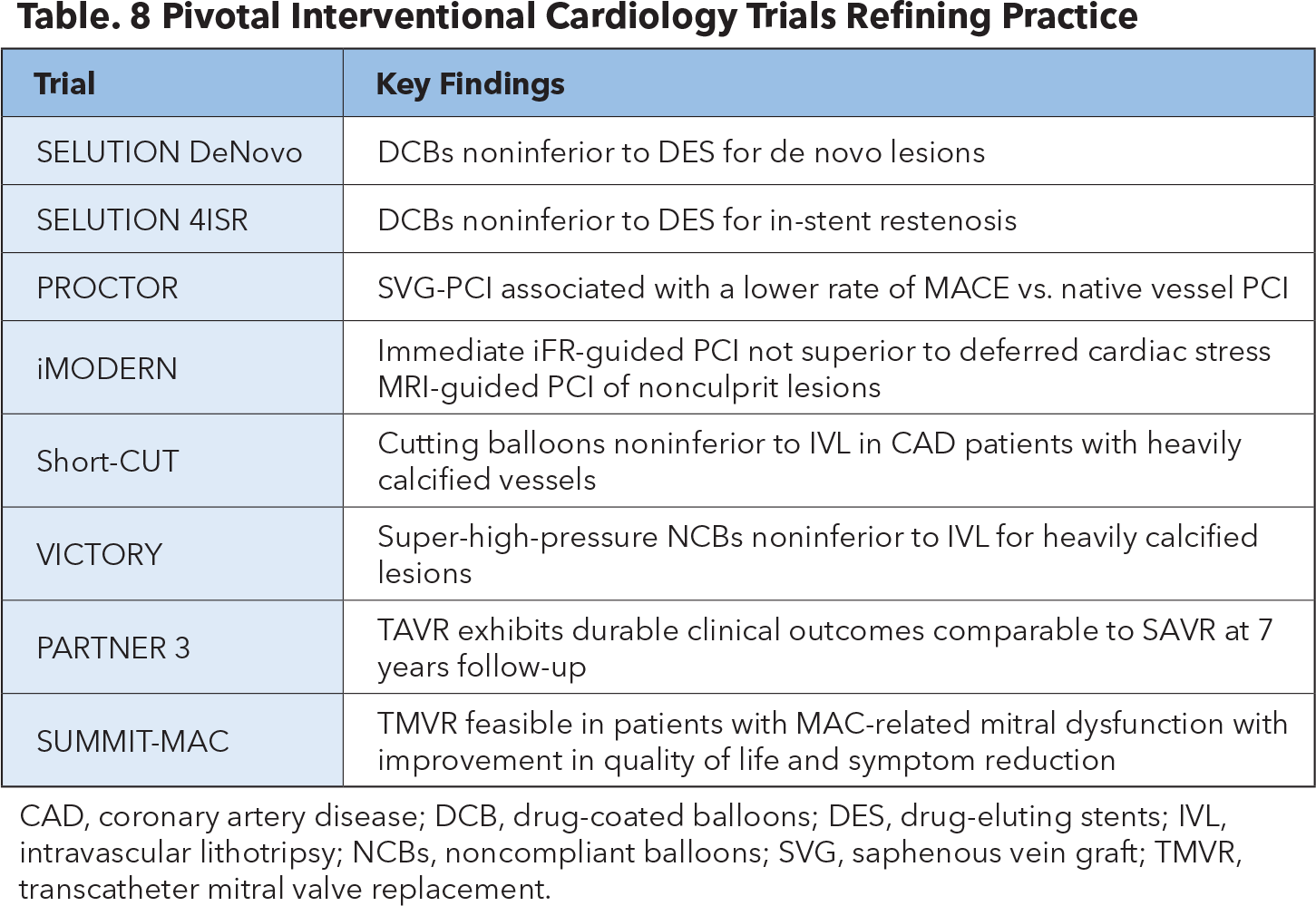

Longer-term data from the PARTNER 3 trial has blurred the distinction between surgical and transcatheter therapy for aortic stenosis among older patients at low surgical risk.9 Among patients with symptomatic, severe aortic stenosis at low surgical risk, no significant differences were observed in seven-year clinical outcomes between TAVR and bioprosthetic surgical aortic valve replacement (SAVR).9 Current guidelines primarily reserve TAVR for older, higher risk patients, but these results suggest comparable durability between TAVR and bioprosthetic SAVR valves.10
On the mitral side, SUMMIT-MAC investigated the use of the Tendyne system (Abbott) in high surgical risk patients with significant mitral valve dysfunction and severe mitral annular calcification.11 This showed that transcatheter mitral valve replacement (TMVR) with Tendyne was safe while also significantly improving quality of life and reducing symptom burden in these patients.11 Current guidelines do not include the option of TMVR for high surgical risk patients. These new findings suggest there may be emerging indications for TMVR consideration.
As interventional cardiology continues to evolve, the data from these trials will further refine clinical practice. Moreover, these trials will likely influence guideline recommendations, with more studies yet to come.
References
- Rao SV, O'Donoghue ML, Ruel M, et al. 2025 ACC/AHA/ACEP/NAEMSP/SCAI guideline for the management of patients with acute coronary syndromes: A report of the American College of Cardiology/American Heart Association Joint Committee on Clinical Practice Guidelines. J Am Coll Cardiol. 2025;85(22):2135-2237.
- Spaulding C, on behalf of the SELUTION DeNovo Investigators. One-Year Results of the SELUTION DeNovo Trial Comparing a Strategy of PCI With a Sirolimus-eluting Balloon and Provisional Stenting Versus Systematic DES Implantation to Treat DeNovo Coronary Lesions. Presented at: Transcatheter Cardiovascular Therapeutics (TCT) 2025; October 25, 2025; San Francisco, CA. Available here.
- Cutlip DE, on behalf of the SELUTION4ISR Investigators. Randomized Trial of a Sirolimus-Eluting Balloon Versus Repeat Drug-Eluting Stenting or Balloon Angioplasty for Coronary In-Stent Restenosis. Presented at: TCT 2025. October 26, 2025. San Francisco, CA. Available here.
- de Winter RW, Hoek R, Walsh SJ, et al. PCI of native coronary artery vs saphenous vein graft after prior bypass surgery: A multicenter, randomized trial. J Am Coll Cardiol. 2026;87(3):269-282. doi:10.1016/j.jacc.2025.09.1577
- Nijveldt R, Maeng M, Beijnink CWH, et al., for the iMODERN Investigators. Immediate or deferred nonculprit-lesion pci in myocardial infarction. N Engl J Med. 2026;394(10):958-968. doi:10.1056/NEJMoa2512918
- Kereiakes DJ, Hill JM, Shlofmitz RA, et al. Intravascular Lithotripsy for Treatment of Severely Calcified Coronary Lesions: 1-Year Results From the Disrupt CAD III Study. J Soc Cardiovasc Angiogr Interv. 2022;1(1):100001. doi:10.1016/j.jscai.2021.100001
- Baron SJ. ShortCUT Trial: Intravascular Lithotripsy vs. Cutting Balloon in Calcified Coronary Lesions. Presented at: Transcatheter Cardiovascular Therapeutics (TCT) 2025; October 26, 2025; San Francisco, CA. Available here.
- Bossard M, Jolyy S, Pinilla N, et al. A Randomized, Multicenter, Non-Inferiority Comparison of Intravascular Lithotripsy and Super-High-Pressure Non-Compliant Balloons for Treatment of Calcified and Refractory Coronary Lesions. The VICTORY Trial. Presented at: Transcatheter Cardiovascular Therapeutics (TCT) 2025; October 26, 2025; San Francisco, CA. Available here.
- Leon MB, Mack MJ, Pibarot P, et al., on behalf of the PARTNER 3 Investigators. Transcatheter or surgical aortic-valve replacement in low-risk patients at 7 years. N Engl J Med. 2026;394(8):773-783. doi:10.1056/NEJMoa2509766
- Otto CM, Nishimura RA, Bonow RO, et al. 2020 ACC/AHA guideline for the management of patients with valvular heart disease: A Report of the American College of Cardiology/American Heart Association Joint Committee on Clinical Practice Guidelines. J Am Coll Cardiol. 2021;77(4):e25-e197.
- Sorajja P, Thourani VH, Rogers JH, et al. Transcatheter mitral valve replacement for severe mitral annular calcification: Primary outcomes from the SUMMIT-MAC Study. J Am Coll Cardiol. 2025;S0735-1097(25)09942-5. doi:10.1016/j.jacc.2025.10.025.
Clinical Topics: Cardiac Surgery, Invasive Cardiovascular Angiography and Intervention, Aortic Surgery
Keywords: Cardiology Magazine, ACC Publications, CM-Jun-2026, Drug-Eluting Stents, Transcatheter Aortic Valve Replacement, Percutaneous Coronary Intervention, Angioplasty, Balloon, Mitral Valve, Coronary Artery Bypass
