Does P2Y12 Inhibitor Monotherapy Reduce NACE, Bleeding in Patients With ACS After PCI?
In patients with acute coronary syndrome (ACS) undergoing PCI, the benefits of shortening dual antiplatelet therapy (DAPT) vary based on monotherapy, with P2Y12 inhibitor monotherapy "significantly reducing" net adverse clinical events (NACE) and major bleeding, whereas aspirin monotherapy had "neutral results," according to a study published Aug. 11 in JACC: Cardiovascular Interventions.
Claudio Laudani, MD, et al., conducted a meta-analysis of 23 randomized control trials with 45,394 patients presenting with ACS undergoing PCI with drug-eluting stent implantation. The weighted mean age was 63 years, 23% were women and 28% had diabetes. The primary endpoint was trial-defined NACE, a composite of bleeding and ischemic events.
Results showed that P2Y12 inhibitor monotherapy reduced the risk of NACE and any bleeding (incidence rate ratio [IRR]: 0.78; 95% CI: 0.64-0.95 for NACE, p=0.026 for interaction; IRR: 0.56; 95% CI: 0.46-0.67 for any bleeding, p=0.008 for interaction), but not aspirin monotherapy (IRR: 1.03; 95% CI: 0.89-1.18). The differences for bleeding endpoints, but not NACE, were mitigated when accounting for DAPT duration.
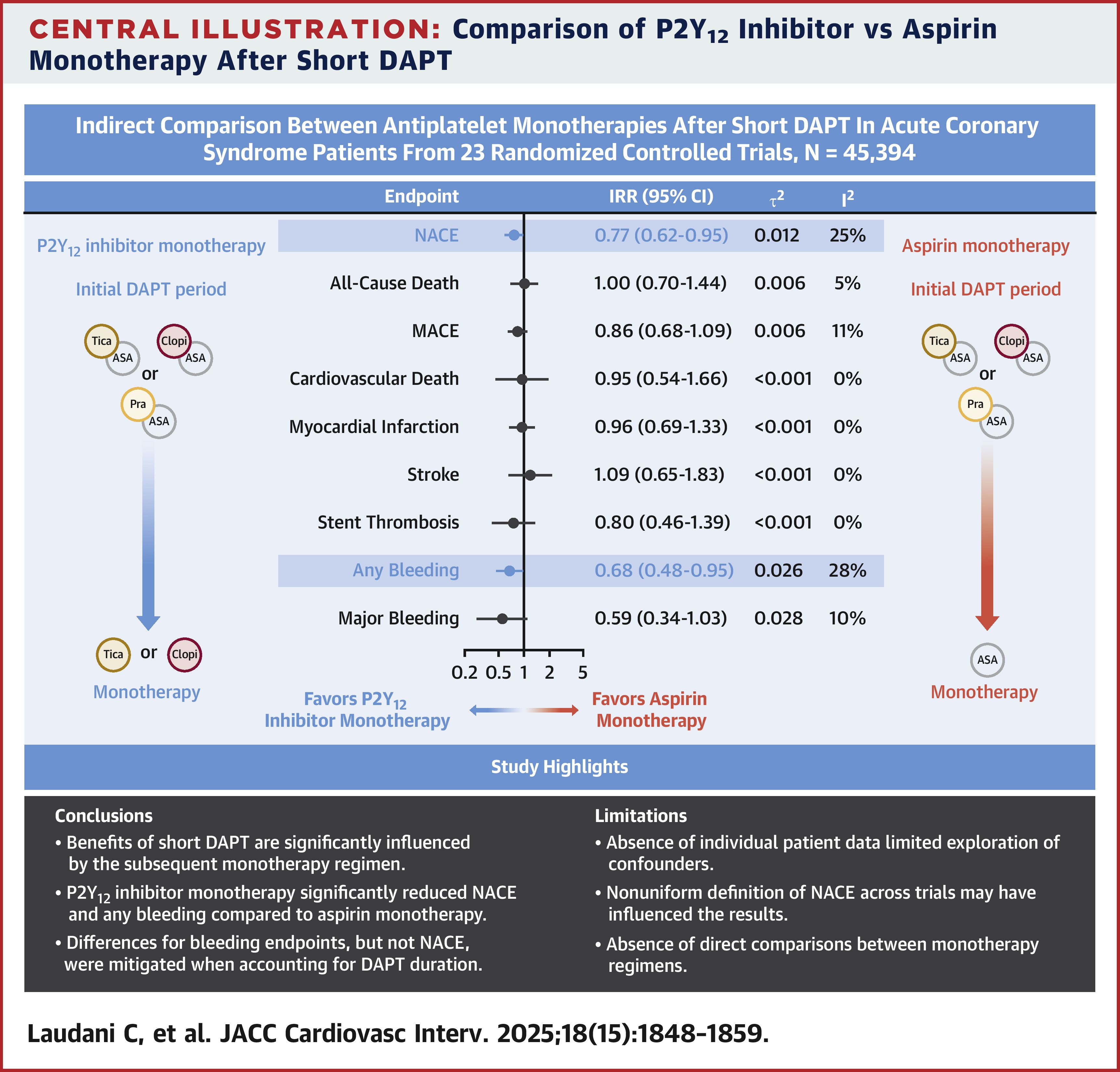
"In patients with ACS undergoing PCI, short DAPT significantly reduces bleeding events, including major bleeding, without increasing ischemic harm," the authors conclude. "However, outcomes vary whether aspirin or P2Y12 inhibitor monotherapy is maintained after a brief period of DAPT, with P2Y12 inhibitor monotherapy significantly reducing long-term NACE, any bleeding and major bleeding, whereas the bleeding benefits achieved with aspirin monotherapy are largely offset by the increased incidence of ischemic events."
In an accompanying editorial comment, Giuseppe Gargiulo, MD; Domenico Simone Castiello; and Giovanni Esposito, MD, PhD, note that "...the actual superiority of short DAPT compared with standard DAPT in ACS, and even more the superiority of P2Y12 inhibitor monotherapy compared with aspirin monotherapy, should be interpreted with caution ... Having said that, we agree with the investigators' conclusion that this meta-analysis can be useful for clinicians and future guidelines on the relative merits of the available antiplatelet monotherapy strategies, allowing a personalized approach depending on the ischemic and bleeding risk balance."
Clinical Topics: Acute Coronary Syndromes, Invasive Cardiovascular Angiography and Intervention, Interventions and ACS
Keywords: Platelet Aggregation Inhibitors, Aspirin, Acute Coronary Syndrome, Drug-Eluting Stents, Percutaneous Coronary Intervention
< Back to Listings


