Meta-Analysis: LAA Patency Associated With Increased Thromboembolic Risk
Residual left atrial appendage (LAA) patency and peri-device leaks (PDLs) following left appendage occlusion (LAAO) detected by cardiac CT may be associated with an increased risk of thromboembolism, indicating they could be clinically significant and should not be regarded as benign, according to a meta-analysis published Sept. 9 in JACC: Cardiovascular Imaging.
The meta-analysis, conducted by Xander Jacquemyn, MD, et al., comprised 17 studies with 2,036 patients post LAAO, with and without LAA patency. The pooled mean age in both patency groups was about 72 years and about 59-62% were men. Of note, those with vs. without LAA patency had a higher pooled CHA2DS2-VASc score (4.2 vs. 4.0; p=0.017) and a lower pooled LVEF (58% vs. 61%; p=0.005). Thromboembolism was defined as a composite of ischemic stroke, transient ischemic attack or systemic arterial thromboembolic events.
Results showed that the incidence of LAA patency was 55% and of PDL was 52%. During the pooled mean follow-up of 1.5 years, the presence of any LAA patency was significantly associated with a nearly twofold increased risk of thromboembolism (pooled odds ratio [OR], 1.87), representing an additional 28 events per 1,000 patients. PDL was not significantly associated with increased thromboembolic risk, but showed a similar trend (pooled OR, 1.50). Using the GRADE framework, the certainty of evidence was rated as high. Bayesian analysis found a 99% and 82% probability of increased thromboembolic risk with LAA patency (mean absolute risk difference [ARD], 2.8%) and PDL (mean ARD, 1.9%), respectively.
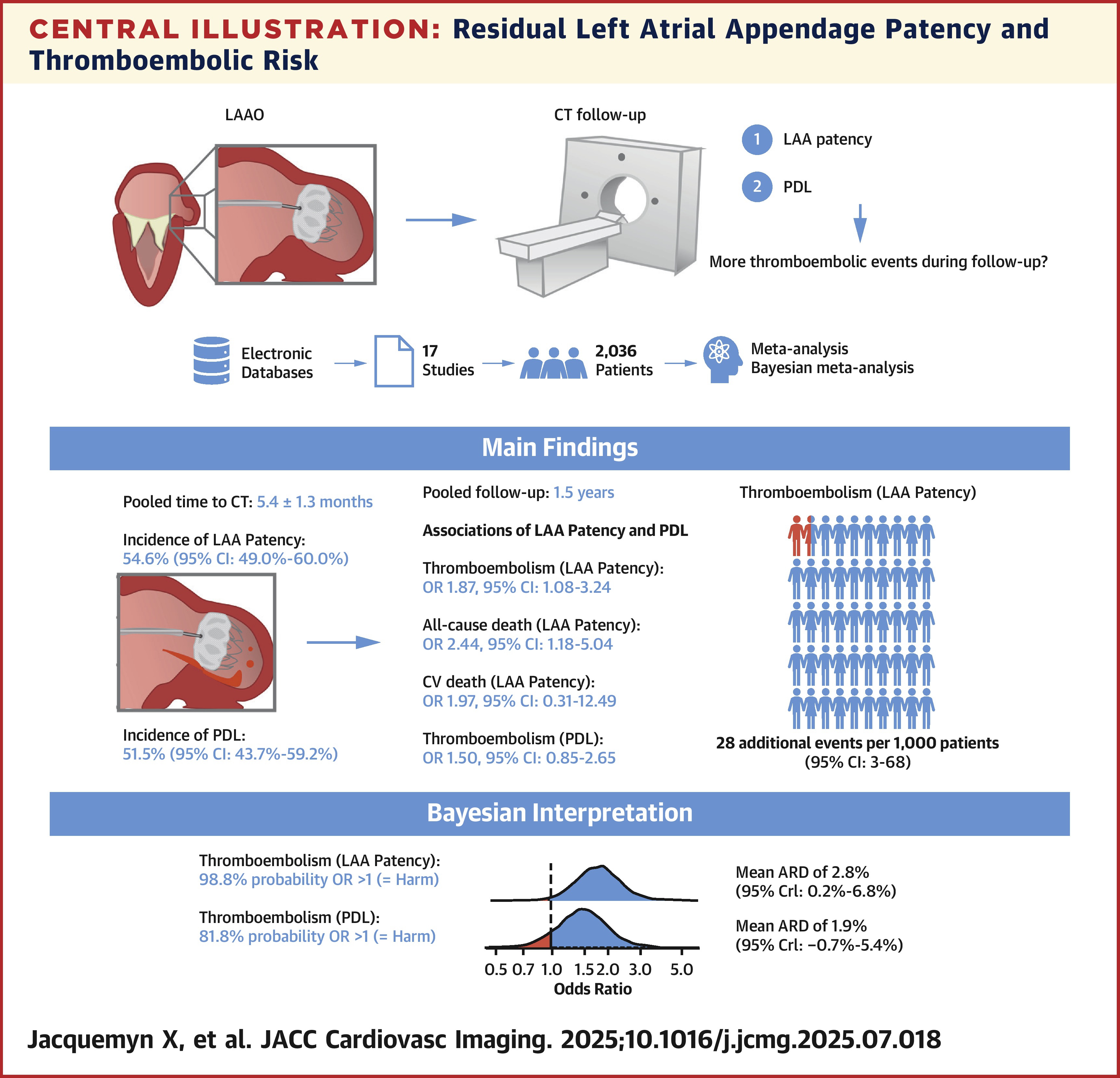
Looking at secondary outcomes, in five of the studies, LAA patency was associated with a higher risk of all-cause mortality (pooled OR, 2.44) but was not significantly associated with cardiovascular mortality (pooled OR, 1.97).
Jaquemyn and colleagues note a high variability in the definitions of LAA patency and PDL across studies. “Despite these discrepancies,” they write, “previous studies have shown excellent inter-reader reliability and agreement using CT detection, making it a reliable tool for guiding prognostic assessments and management decisions.”
Clinical Topics: Noninvasive Imaging, Computed Tomography, Nuclear Imaging
Keywords: Atrial Appendage, Thromboembolism, Tomography, X-Ray Computed
< Back to Listings


