Is a Multimodal AI Model Superior to LVEF in Predicting SCD in Patients With CS?
When predicting sudden cardiac death (SCD) risk in patients with cardiac sarcoidosis (CS), a multimodal artificial intelligence (AI) for ventricular risk stratification in CS (MAARS-CS) may offer superior predictive accuracy and consistency vs. LVEF, according to a retrospective cohort study published Dec. 5 in JACC: Clinical Electrophysiology.
Changxin Lai, PhD, et al., studied 317 patients with CS evaluated at Johns Hopkins Hospital between 2005 and 2022. CS diagnosis was based on extra cardiac confirmatory histopathology, and patients were followed for a mean duration of 8.5 years. The cohort was used to test and train MAARS-CS using 5-fold cross-validation. MAARS-CS used an electronic health records branch using a feedforward neural network for clinical covariates, a 3-dimensional convolutional neural network for late gadolinium enhancement (LGE)-cardiac magnetic resonance imaging (CMR) analysis and a classifier integrating multimodal information to predict personalized SCD risk to comprise a CMR branch.
The analysis demonstrated the performance improvements of MAARS-CS in predicting SCD risk, as well as how variations in LGE-CMR image quality and magnetic resonance sequences affect the model's performance. Of note, the authors also performed interpretation analyses to explain the model predictions and uncover the insights it has gleaned from clinical data and LGE-CMR images.
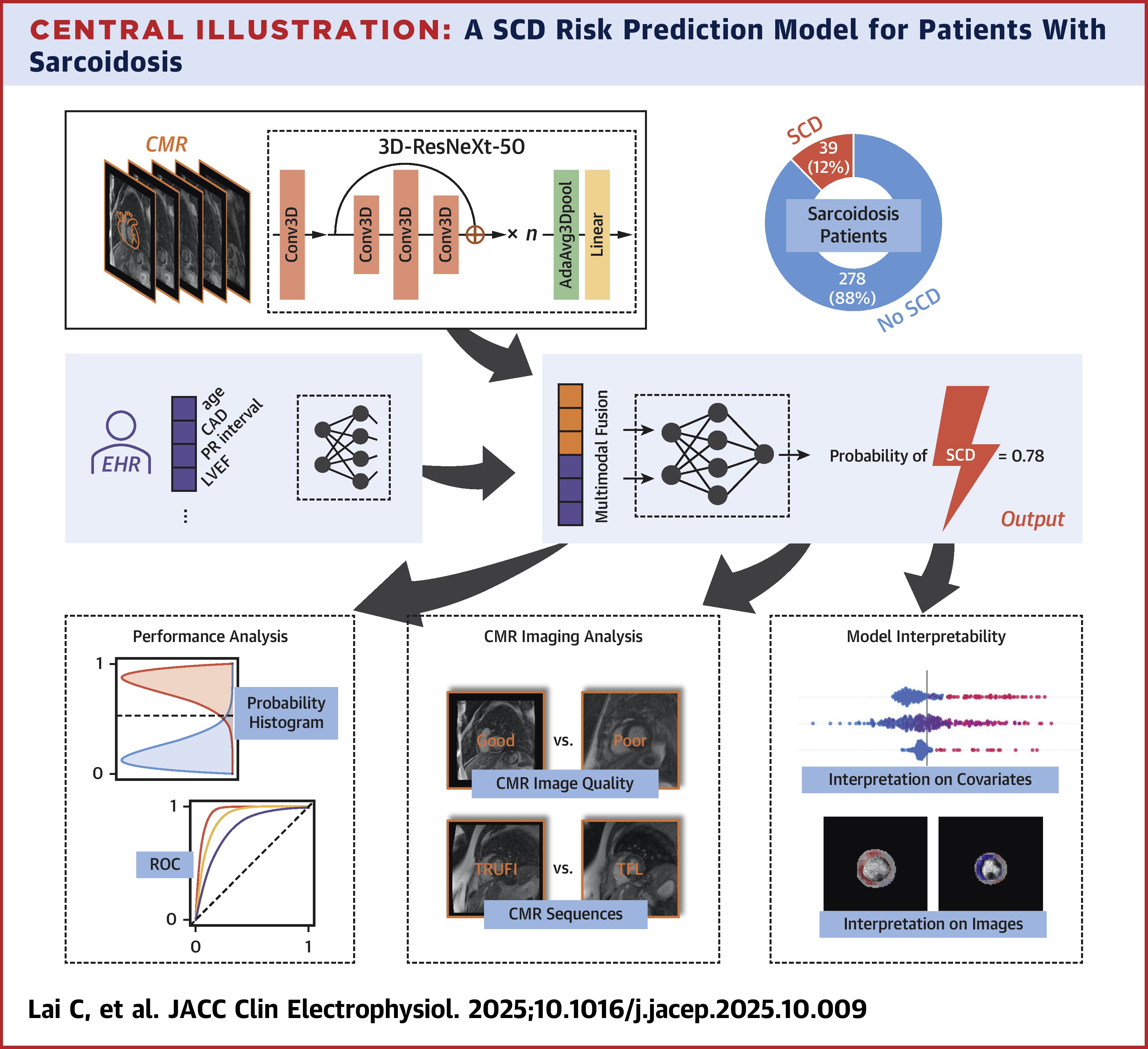
Results showed that MAARS-CS significantly outperformed the LVEF ≤35% criterion (area under the receiver-operating characteristic curve [AUROC]: 0.59; p<0.0001 compared with MAARS-CS) and continuous LVEF (AUROC: 0.77; p=0.019 compared with MAARS-CS) by achieving an AUROC of 0.86. Additionally, when compared with LVEF, MAARS-CS showed higher area under the precision-recall curve (0.54 vs. 0.43) and balanced accuracy (0.83 vs. 0.74).
MAARS-CS maintained robust performance across varying magnetic resonance sequences and varying image qualities, and interpretation analysis identified important image regions and key clinical covariates contributing to SCD risk predictions.
"These results underscore the potential of multimodal AI to radically shift the risk assessment paradigm for patients with CS from the current 'one-size-fits-all' rule to AI-assisted personalized care, enhancing arrhythmia management and reducing unnecessary ICD deployments," write Lai and colleagues.
Clinical Topics: Arrhythmias and Clinical EP, Heart Failure and Cardiomyopathies, Implantable Devices, SCD/Ventricular Arrhythmias, Atrial Fibrillation/Supraventricular Arrhythmias
Keywords: Artificial Intelligence, Death, Sudden, Cardiac, Sarcoidosis, Magnetic Resonance Spectroscopy, Gadolinium, Electrophysiology, Ventricular Function, Left
< Back to Listings


