
Molecular Imaging Biomarker a Prognostic Indicator in PAH?
Uptake of fluorine-18-fibroblast activation protein inhibitor (18F-FAPI) in the right ventricular (RV) free wall, as captured by PET/CT, is a promising, noninvasive indicator for pulmonary arterial hypertension (PAH), according to new research published Jan. 8 in JACC: Cardiovascular Imaging.
Study authors Hai-Ming Chen, MD, et al., retrospectively tracked worsening clinical events (death, transplant, rehospitalization or therapy escalation) in 46 patients with PAH (mean age 34; 67% women) who had undergone PET/CT with 18F-FAPI between August 2022 and June 2024, stratifying them into three risk groups: low (41%), intermediate (46%) and high (13%). The most common type of PAH among patients was idiopathic (57%), followed by PAH associated with congenital heart disease (24%) and connective tissue disease (11%).
Results over a median follow-up of 17 months showed that 22 patients (48%) experienced worsening clinical events. A higher 18F-FAPI uptake, measured in the target-to-background ratio (TBR) for the RV and pulmonary arteries, indicated a more severe disease – increasing with higher risk strata (p<0.05), and significantly higher in clinical worsening vs. nonclinical worsening patients (p<0.05).
Multivariable Cox regression analysis found TBR of the RV free wall (TBRRVFW) to be an independent predictor of clinical worsening (hazard ratio [HR], 1.699; p=0.007; area under the curve [AUC], 0.75). Combining this indicator with World Health Organization functional class and RV fractional area change further improved AUC to 0.83. Kaplan-Meier curves also found patients with TBRRVFW >2.1 to have a poorer prognosis (log-rank p=0.005).
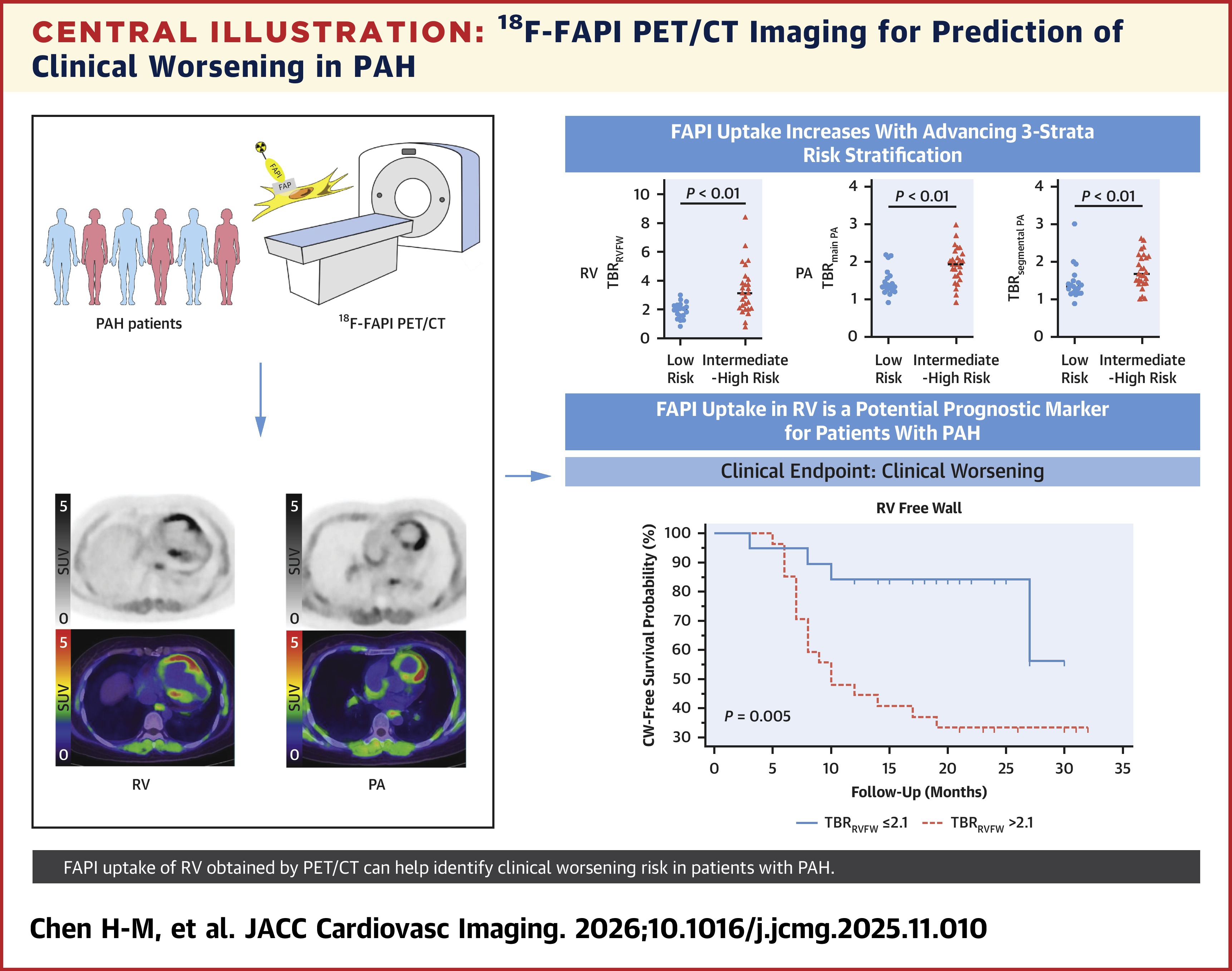
"FAPI PET/CT may provide a new perspective for the evaluation of PAH and serve as a useful adjunct for established imaging markers to refine risk stratification in PAH," write the study authors, adding that "future studies are warranted to better understand the RV-PA coupling in PAH and to investigate the effects of PAH-targeted medical therapy on FAPI uptake and the impact of such changes on outcomes."
Clinical Topics: Heart Failure and Cardiomyopathies, Invasive Cardiovascular Angiography and Intervention, Noninvasive Imaging, Pulmonary Hypertension and Venous Thromboembolism, Pulmonary Hypertension, Interventions and Imaging, Computed Tomography, Nuclear Imaging
Keywords: Positron Emission Tomography Computed Tomography, Pulmonary Arterial Hypertension, Fibroblasts, Fluorodeoxyglucose F18
< Back to Listings


