Feature | Expanding the Cardiologist's Lens: The Urgency of PAD Management

By the time the patient entered the clinic, he was just days away from losing his leg and he had already been told amputation was inevitable. "He had ulcers on his toes, his foot was cold and nobody had checked his pulses," said Craig M. Walker, MD, medical director of the Cardiovascular Institute of the South in Lafayette, LA. He was speaking during a recent webinar on career pathways in vascular medicine hosted by ACC's Vascular Disease Section in collaboration with the Society for Vascular Medicine.
Fortunately, however, the man didn't lose his leg. "Within hours," Walker said, "we opened up his arteries, restored flow and that same leg is still on him today."
For Walker, a pioneer in peripheral interventions, the case epitomizes what's wrong – and what could be right – in the care of patients with peripheral artery disease (PAD).
"There's a massive population of patients who could be helped by cardiologists who already have the tools and the knowledge," he said. "We just have to recognize that PAD isn't separate from what we do – it is cardiovascular disease."
A Silent Epidemic
PAD is the result of atherosclerosis, affecting extremity, carotid, vertebral, mesenteric and renal arteries. By far the most common manifestation is in the lower extremity arteries feeding the feet and toes.
The disease is associated with an increased risk of amputation, myocardial infarction, stroke and death.1 Yet it is "grossly underdiagnosed and undertreated," says Pradeep Nair, MD, FACC, an interventional cardiologist at the Cardiovascular Institute of the South. Thus, by the time patients are properly diagnosed they often have chronic limb-threatening ischemia (CLTI) and require amputation.
PAD affects 21 to 27 million Americans, according to revised estimates,2 up substantially from previous estimates. An aging population coupled with the diabetes epidemic is driving the increase, Nair says.
There are also significant racial and ethnic disparities in PAD. Although Black and White Americans develop PAD at similar rates, Blacks consistently experience worse outcomes, including amputation rates as much as 65% higher than Whites, and elevated mortality rates. They are also less likely to receive guideline-directed therapies than Whites and although they are more likely to present with advanced disease requiring urgent intervention, Blacks receive revascularization less often. Even when receiving procedures, they face higher rates of complications and amputation within the first year.3

Numerous factors contribute to the disparity, including income level, insurance coverage and health care access. Another is access to specialists. "I have patients drive three hours to see me," says Cameron W. Donaldson, MD, FACC, a vascular interventional cardiologist based in Portland, ME. His state and much of the South suffer from "vascular deserts," he says, where there are few specialists trained to treat vascular conditions. Such vascular deserts result in high rates of CTLI and amputation.4
Overall, the quality of care provided today remains poor. For instance, 60-80% of those with CLTI do not receive an angiogram before amputation, and in 50-70% there is no attempt at revascularization. The result, Nair says, is "an epidemic of major amputations."
"A classic situation I see almost every week is a patient with CLTI who has a wound on their leg and who was seen by a cardiologist, but the patient didn't take off their shoes and socks or they just weren't examined," says Donaldson. Patients often don't mention a wound because they may not feel it, due to neuropathy. Even if they do, he notes, they are often told to go to the podiatrist or primary care doctor for care. "I see it regularly and it scares me."
Patients with late-stage lower-limb PAD are significantly likely to end up with an amputation. That, in turn, leads to a high mortality rate, with half of all patients who undergo a lower limb amputation dying within two to four years. In fact, individuals are more likely to die within five years of an amputation than from any cancer except lung cancer, Nair says. In addition, a third of these patients end up in nursing homes. About half with a below-the-knee amputation and 75% of those with above-the-knee amputations never regain mobility.5
Cardiologists Can Change the Trajectory
"Cardiologists see PAD every day," says Donaldson. "All of our patients have it. We're focused on the heart, but cardiovascular disease isn't just cardiac disease – it's cardiac and vascular." After all, he adds, the board certification is in cardiovascular disease.
"You can't care for people with heart disease and not vascular disease because everyone with heart disease has vascular disease," he emphasizes.
Historically, vascular surgery was the domain that mainly treated PAD. But with only about 4,000 vascular surgeons in the U.S., there are far too few to meet the growing need. Moreover, they are trained to deal with the late-stage problems, like amputations and strokes.
"It's up to cardiologists to get to these patients before they reach that point," Donaldson says.
However, despite the need for more vascular specialists, there is no American Board of Internal Medicine board certification in vascular medicine, despite decades-long efforts. The condition also doesn't get a strong focus in training. Nair recalls learning very little about PAD during his residency and cardiology fellowship.
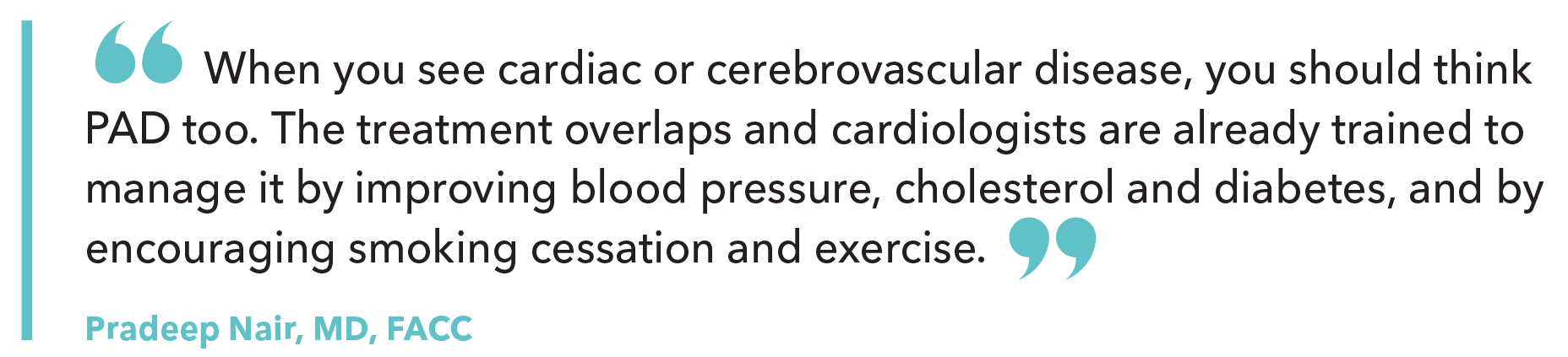
Yet PAD is a critical marker of polyvascular disease "When you see cardiac or cerebrovascular disease, you should think PAD, too," Nair says. "The treatment overlaps and cardiologists are already trained to manage it by improving blood pressure (BP), cholesterol and diabetes, and by encouraging smoking cessation and exercise."
Basic bedside care is a large part of the solution, notes Nair. Look at the legs, check for hair loss and nonhealing wounds, and palpate pedal pulses. Screening can start with a simple ankle-brachial-index (ABI). The normal ABI range is 1.00 to 1.40. An ABI value of 0.91 to 0.99 is borderline and an ABI of ≤0.90 is abnormal. An ABI <0.40 signals a markedly increased risk of mortality.6
Importantly, do not rely on the patient to tell you what's going on, says Nair. They do not always have pain and often the PAD is subclinical, which can be a marker for vascular disease in another area.
Plus, unlike the coronary artery, "we can easily check the pulse in a foot," making this an easily accessible vascular conduit to evaluate for the absence of a pulse, which could be a marker of a much larger problem.
This requires a shift – rethinking routine practice to include assessment for PAD, says Donaldson. A full pulse exam, head to toe, is needed, along with listening to the heart and lungs.
In his practice, the medical staff is trained to have patients take off their shoes and socks so the doctor can easily examine the foot. They are also trained to measure BP in both arms. "Subclavian stenosis is quite common. If there is a blockage in one of the arteries in an arm, it will not be picked up unless a difference in BP is identified," he highlights.
Whether general or more specialized, cardiologists should take the lead on PAD prevention and early diagnosis. They already manage risk factors that drive PAD. Getting those parameters under control can greatly improve limb as well as cardiovascular outcomes.
One challenge, Donaldson notes, is time. "Most cardiologists are so busy caring for heart failure, heart attacks and arrhythmias that they don't have five extra minutes to check pulses or ask about pain when walking."
The Knowledge Gap: A Barrier to Care
Another challenge is lack of awareness among the public and clinicians, particularly primary care physicians, about PAD.7,8
Indeed, multiple studies and reviews find that PAD is frequently underdiagnosed and undertreated, even though cardiologists are well-positioned to identify and manage it. This underappreciation is attributed to limited awareness, misconceptions about disease severity and insufficient training in vascular disease.7,9

Even surveys of cardiologists find a substantial proportion rate their knowledge of PAD risk reduction therapies as below average, and many are unfamiliar with management guidelines and racial disparities in the disease.10,11
Donaldson and Nair aren't surprised. "It's the neglected side of our training," Donaldson says. "We owe it to our patients to treat the vascular problems they have everywhere – in the legs, brain and kidneys."
Most interventional cardiologists already possess the imaging judgment, access techniques, and wire-and-catheter skills needed for many PAD interventions that can restore in-line flow, reduce tissue loss and improve function, Nair notes. "However, I strongly recommend they seek further training to understand the intricacies of peripheral vascular interventions."
The field is quite dynamic, with new procedures and devices advancing the science. In 2023, the U.S. Food and Drug Administration approved a device that allows for deep vein arterialization to treat patients with CLTI whose only other option is amputation. The minimally invasive procedure creates a bypass from an artery to a deep vein in the foot to restore blood flow, potentially saving limbs from amputation.
The seminal clinical trial on the device showed that 76% of patients were able to avoid amputation and experienced progressive wound healing at six months.12 Nair has seen it in his own practice, when he performed the procedure on a patient with a gangrenous foot. Two doctors told the patient he needed an amputation, but Nair was able to save the foot. "And then with good wound care and follow up he was able to walk."
The 2024 ACC/AHA guideline for lower extremity PAD diagnosis and management recommends team-based care, high-intensity statins, single antiplatelet therapy in most PAD patients, aggressive BP and diabetes management, smoking cessation and structured exercise therapy – and, when indicated, revascularization to prevent limb loss in CLTI and to improve quality of life in claudication.1
Indeed, studies find that geographic regions with quality vascular care can significantly reduce the risk of CLTI and the rate of amputations in patients with PAD.13,14 The challenge is getting that care to patients early on.
"I feel strongly that education is the foundation for everything," says Donaldson. "If we want to make a change in outcomes for our patients with PAD, we must start with education, starting with informing ourselves."
Editors' Note: This is the first article in a two-part series on peripheral vascular disease. Watch for the second article on training pathways in vascular medicine for cardiologists in the next issue.
References
- Gornik H, Aronow H, Goodney P, et al. 2024 ACC/AHA guideline for the management of lower extremity peripheral artery disease. JACC 2024;83:2497-2604.
- Yost ML. The current U.S. prevalence of peripheral arterial disease. Vascular Disease Management 2023;20:E67-E73..
- Thomas VE, Beckman JA. Racial and socioeconomic health disparities in peripheral artery disease. J Am Heart Assoc 2024;13: e031446.
- DiLosa KL, Nguyen RK, Brown C, et al. Defining vascular deserts to describe access to care and identify sites for targeted limb preservation outreach. Ann Vasc Surg 2023;95:125-32.
- Allie DE, et al. Critical limb ischemia: a global epidemic. EuroIntervention 2005;1(1).
- Newman AB, Shemanski L, Manolio TA, et al. Ankle-arm index as a predictor of cardiovascular disease and mortality in the Cardiovascular Health Study. The Cardiovascular Health Study Group. Arterioscler Thromb Vasc Biol 1999;19:538-45.
- Fioretti V, Gerardi D, Giugliano G, et al. Focus on prevention: peripheral arterial disease and the central role of the cardiologist. J Clin Med 2023;12:4338.
- Keelan S, Foley N, Healy D, et al. Poor patient awareness of peripheral arterial disease, it is time to optimize the clinical visit. Surgeon 2022;20:157-63.
- Criqui M, Matsushita K, Aboyans V, et al. Lower extremity peripheral artery disease: contemporary epidemiology, management gaps, and future directions: a scientific statement from the American Heart Association. Circulation 2021;144:e171-e191.
- De Melo Felix CM, Pereira D, Pakosh M, et al. A Scoping review of measurement tools evaluating awareness and disease-related knowledge in peripheral arterial disease patients. J Clin Med 2023;13:107.
- Jones K, Karambe A, Sadik K, Hernandez B. Abstract 4141112: Identifying Gaps in Screening and Treatment for Peripheral Artery Disease: A Survey on Provider Knowledge, Attitudes, and Practices. Circulation 2024.
- Shishehbor MH, Powell RJ, Montero-Baker MF, et al. Transcatheter arterialization of deep veins in chronic limb-threatening ischemia. New Engl J Med 2023;388:1171-80.
- Creager MA, Matsushita K, Arya S, et al. Reducing nontraumatic lower-extremity amputations by 20% by 2030: time to get to our feet: a policy statement from the American Heart Association. Circulation 2021;143: e875-e91.
- de Mestral C, Hussain MA, Austin PC, et al. Regional health care services and rates of lower extremity amputation related to diabetes and peripheral artery disease: an ecological study. CMAJ Open 2020;8:E659-e66.
Clinical Topics: Vascular Medicine, Atherosclerotic Disease (CAD/PAD)
Keywords: Cardiology Magazine, ACC Publications, Renal Artery, Peripheral Arterial Disease, Myocardial Infarction
