Prioritizing Health | Front-of-Package Labeling: A New Tool For CV Prevention
With front‑of‑package (FOP) nutrition labeling gaining prominence as a practical strategy to support healthier eating patterns, new ACC Concise Clinical Guidance underscores its potential to help reduce cardiovascular disease risk. By drawing attention to key nutrients like sodium, saturated fat and added sugars, the report highlights how FOP labeling can serve as a catalyst for empowering consumers to make healthier, more informed dietary choices.
Don't Miss the Pathway to Prevention at ACC.26
The Cardiovascular Disease Prevention Learning Pathway at ACC.26 will spotlight the rapidly evolving world of preventive strategies and gives clinicians practical tools to bring cutting‑edge innovations into everyday care. View pathway highlights and get a first look at the latest guidelines, therapies and evidence shaping prevention today.
The report synthesizes current evidence on FOP effectiveness and outlines considerations for developing a transparent, science‑based policy that centers around public health while offering clarity for food manufacturers. It also supports ongoing U.S. Food and Drug Administration (FDA) efforts to establish a standardized national FOP system, pointing to experiences in 44 countries where similar approaches have increased consumer awareness, improved purchasing behaviors and, in some cases, prompted reformulation of food products.
"Nutrition is foundational to cardiovascular health; however, the overabundance of food choices and inconsistent messaging have created confusion among the public," says Writing Committee Chair Kim Allan Williams, MD, MACC. "FOP labeling presents an opportunity to translate nutrition science into real-world consumer guidance and provide a rapid, visual cue at the point of purchase that highlights nutrients most relevant to chronic disease risk like saturated fat, sodium and added sugars."
According to the report, FOP labels would complement current "Nutrition Facts" on the back of packaging, not replace them, and would use illustrations, symbols and systems that are easy to understand. For example, the "Traffic Light Approach," which uses red, yellow and green to indicate whether a product contains high, medium or low amounts of fats, sugar or sodium, is one common approach used to more easily assist individuals in understanding nutritional values and broaden the reach of nutrition education.
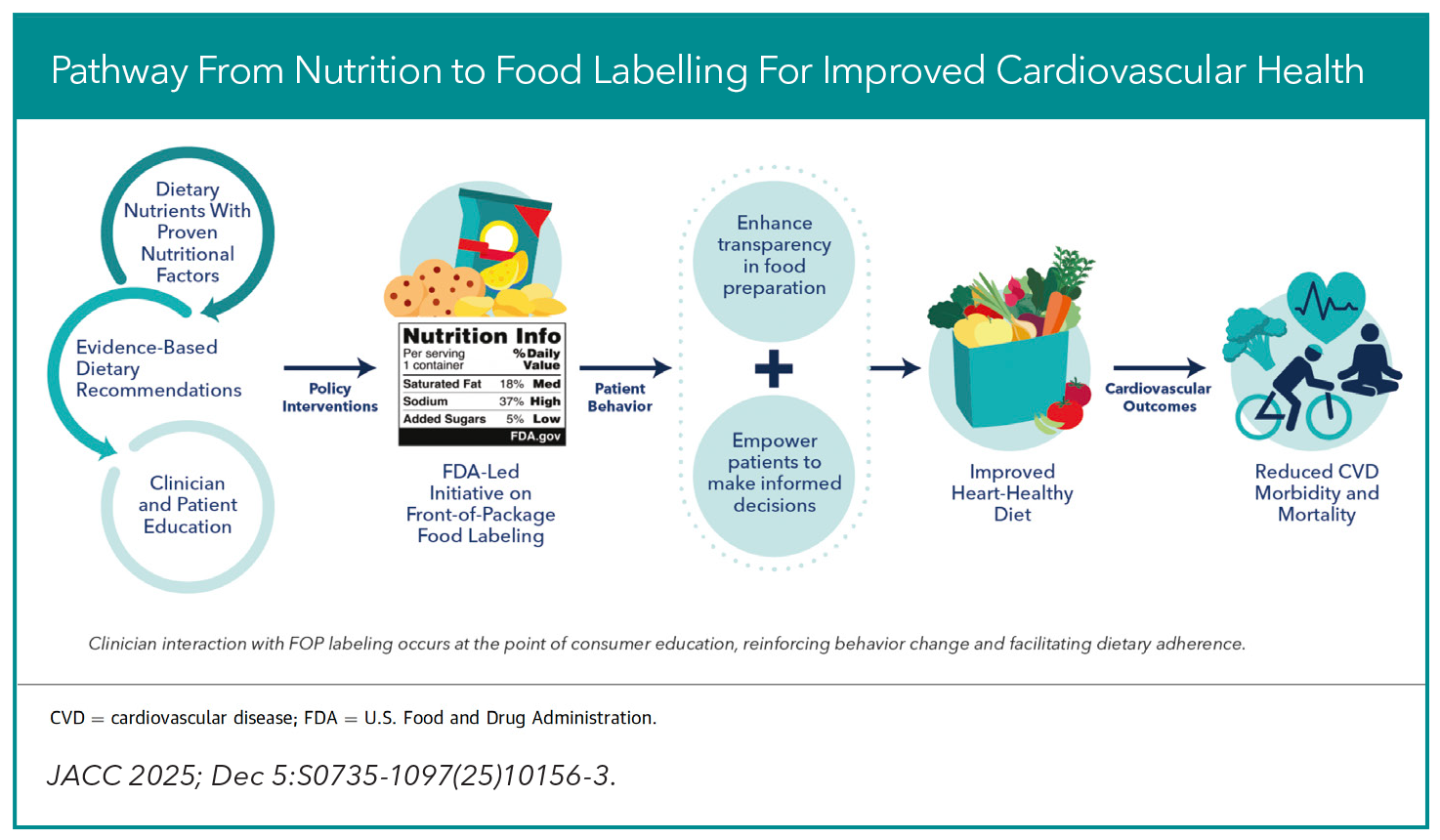
The document also emphasizes the clinician's role in reinforcing dietary patterns that are lower in saturated fat, added sugars and sodium and higher in minimally processed foods, fiber, fruits, vegetables, legumes and whole grains. Guidance is provided on how to counsel patients on sustainability, food safety concerns and how to interpret nutrition labels, stressing the need for patience, empathy and cultural competence to meet patients "where they are."
"When coupled with clinician education and culturally sensitive counseling, FOP labeling helps overcome barriers related to health literacy, culture and socioeconomic constraints," the document states. "Integrating these approaches into practice empowers both clinicians and patients to make sustainable, informed food choices, ultimately improving cardiovascular outcomes at the individual and population levels."
Read the new CCG Report in JACC.
Clinical Topics: Prevention, Diet
Keywords: Cardiology Magazine, ACC Publications, CM-Jan-Feb-2026, Food Labeling, Nutrition Policy, Health Literacy, Primary Prevention, Diet
