Cover Story | Global Pulse Check: Understanding the State of the Health Care Workforce

As health systems worldwide grapple with growing demands, workforce shortages and the increasing burden of noncommunicable diseases (NCDs), understanding the experiences and perspectives of frontline clinicians is more essential than ever. A recent global survey of health care professionals, conducted by the ACC and supported by Viatris, offers a revealing snapshot into the realities of clinical practice today – highlighting trends in job satisfaction, financial compensation, team-based collaboration and burnout across various practice settings ranging from community clinics to hospitals.
Notably, two-fifths or more of the survey respondents from each region reported participating in the free, online NCD Academy, a collaboration between the ACC, the NCD Alliance and the World Heart Federation, providing a unique lens into how professional development may shape clinical engagement and well-being.
The data not only underscore persistent challenges across geographies and roles, but also point toward potential pathways for building a more resilient, collaborative and effective global health care workforce able to tangibly address the NCD crisis.
"Noncommunicable diseases have assumed epidemic proportions," said one physician from the United Arab Emirates (UAE). "Clinicians are ill equipped to handle these challenges in the primary prevention of these diseases. Participating in NCD Academy courses address some of these unmet needs and challenges."
By The Numbers
A total of 799 clinicians from across Africa, the Americas, Southeast Asia, Europe, the Eastern Mediterranean and the Western Pacific participated in the survey. Among countries within these regions, the highest numbers of respondents came from China (n=200), the UAE (n=173), Mexico (n=65), India (n=25) and Greece (n=14).
Participants represented a broad spectrum of clinical roles, encompassing the full care team – from nurses, community educators and health care workers to medical students, pharmacists and physicians. Physicians comprised the vast majority of respondents in all regions (more than 60%), except for Africa. In that region, physicians made up nearly 40% of respondents, followed by community health care workers (11%) and pharmacists (9%).
The majority of survey respondents across all regions identified cardiovascular disease, family medicine and internal medicine as their primary areas of focus or specialty. Other specialties included emergency medicine, endocrinology, infectious disease, mental health and oncology. Of those who identified cardiology as their primary focus, general cardiology, heart failure, interventional cardiology, critical care cardiology and cardiac imaging were most prevalent.
Clinical settings varied by region. In Africa, nearly half of respondents reported working in local (19%) or regional hospitals (28%), followed by private hospitals (17%), urban community clinics (13%) and rural community clinics (9%). In the Americas, 54% of clinicians were based in hospital settings – split between private (26%) and local/regional hospitals (14% for each) – with urban community clinics accounting for another 20%. In Southeast Asia, where approximately 70% of respondents were from India, private hospitals were the most common work setting (35%), followed by local hospitals (18%).
Among the 38 European respondents, nearly half were employed in either urban community clinics (21%) or regional hospitals (21%). In the Eastern Mediterranean, represented largely by respondents from the UAE, 40% reported working in private hospitals, with another 20% based in urban community clinics. In the Western Pacific, where 86% of participants were from China, Tier 3 hospitals were the dominant setting (42%), followed by local hospitals (20%) and Tier 2 hospitals (16%).
Across all regions, 81% of respondents reported working in moderately to highly collaborative environments – where care is shared among secondary care providers, nurses, pharmacists and community health workers. Clinicians in the Eastern Mediterranean reported the highest levels of collaboration, with 59% indicating they work in highly collaborative settings and 27% noting moderately collaborative work environment.
Job Satisfaction and Burnout
In general, the vast majority of clinicians across all regions reported overall satisfaction with their work. Survey respondents in Southeast Asia reported the greatest satisfaction (91%), while those from Europe and the Western Pacific were less satisfied at 66% and 74%, respectively. Clinicians from Africa, the Americas, Southeast Asia and Eastern Mediterranean, who had also taken part in the NCD Academy, were most likely to be "very satisfied" with their roles. Survey respondents from Africa and Europe expressed the most dissatisfaction at 14% and 24%, respectively.
Satisfaction with financial compensation varied by region. In Africa, nearly half of respondents (49%) reported being moderately or very dissatisfied with their compensation, while 35% expressed some level of satisfaction. In the Americas, where most respondents were from Mexico, only 27% reported dissatisfaction, compared to 57% who were moderately or very satisfied. In Southeast Asia, 35% of clinicians indicated dissatisfaction, while 56% reported being satisfied. In Europe, 45% of respondents were satisfied with their compensation, compared to 32% who were not. In the Eastern Mediterranean, satisfaction levels were highest, with 65% expressing satisfaction and only 20% reporting dissatisfaction. In the Western Pacific, 30% of respondents reported some level of dissatisfaction, while half (50%) said they were satisfied with their compensation.
When asked about burnout, roughly 29% of clinicians from Africa, the Americas, Southeast Asia, Europe, Western Pacific and the Eastern Mediterranean reported experiencing burn out, such as emotional exhaustion, depersonalization and reduced personal accomplishment.
Burnout symptoms were greatest (39%) among clinicians in the Western Pacific, as well as among community health workers and medical students – audiences where tools like NCD Academy may provide added support.
Feelings of stress and lack of energy, but not burnout, were prevalent across roughly 40% of survey respondents from Africa, the Americas and Southeast Asia, and roughly 50% of those from Europe and the Western Pacific. These feelings were least likely in the Eastern Mediterranean where 45% of survey respondents said they enjoyed their work and had no symptoms of burnout.
The NCD Academy Effect
In 2015, the United Nations set forth its Sustainable Development Goals, including Target 3.4, a bold commitment to reduce premature mortality from NCDs by one-third by 2030. The NCD Academy was launched in direct response to this global mandate, offering free, concise and clinically relevant training modules designed to empower internists, general practitioners, specialists, nurses and community health workers around the world. The curriculum addresses key drivers of morbidity and mortality, with focused modules on cardiovascular disease, diabetes, cancer, chronic respiratory disease, HIV and stroke, as well as emerging topics like mental health, health equity and advocacy.
Survey data show that the Cardiovascular Disease and Stroke Prevention course is the most widely accessed course across all regions, followed by the course on Diabetes Care. The course on Mental Health ranked particularly high in Africa, the Americas and Southeast Asia, while the Chronic Respiratory Disease course was among the most viewed in Europe and the Eastern Mediterranean. Notably, clinicians in the Eastern Mediterranean reported the highest overall participation in NCD Academy offerings.
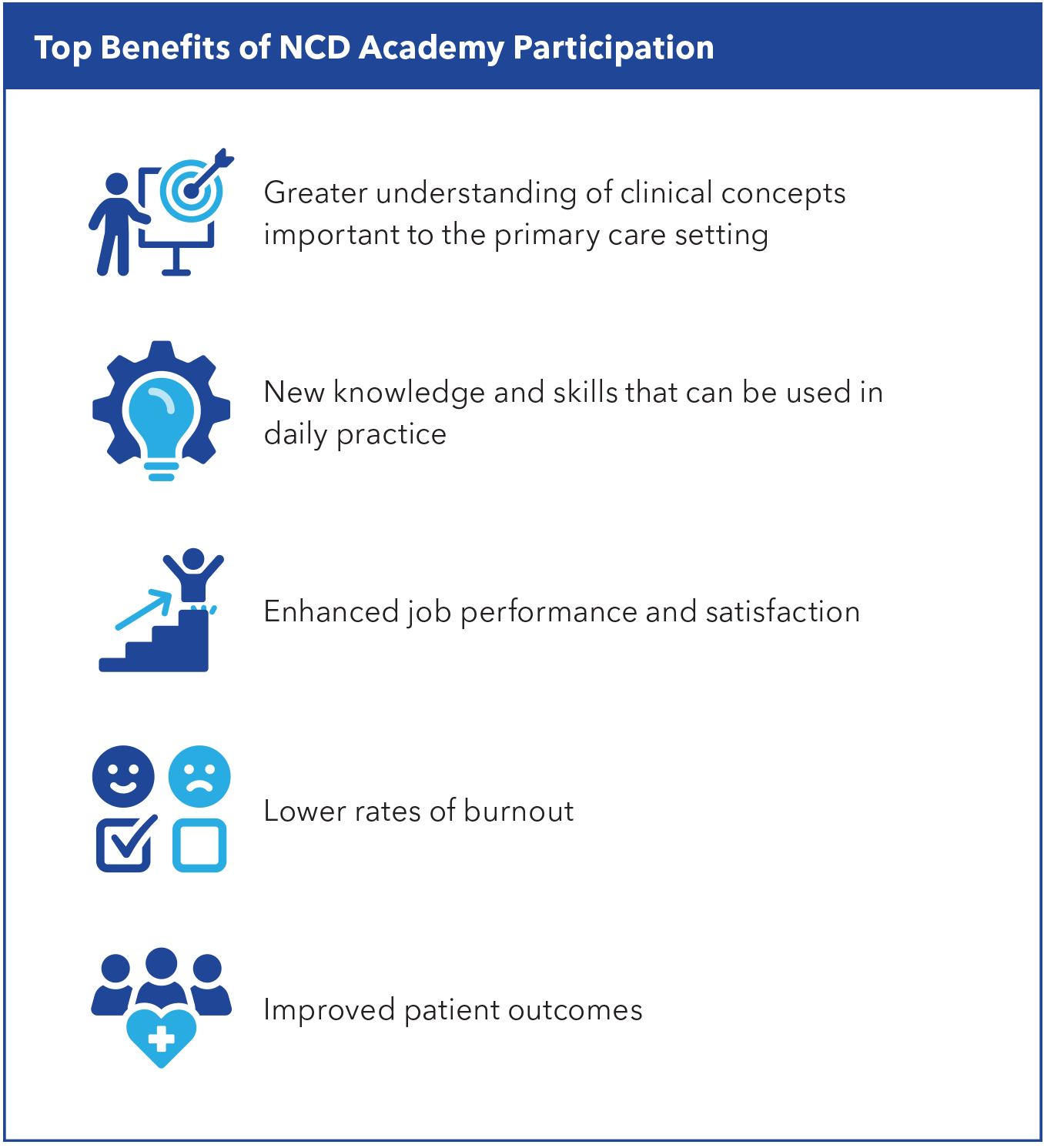
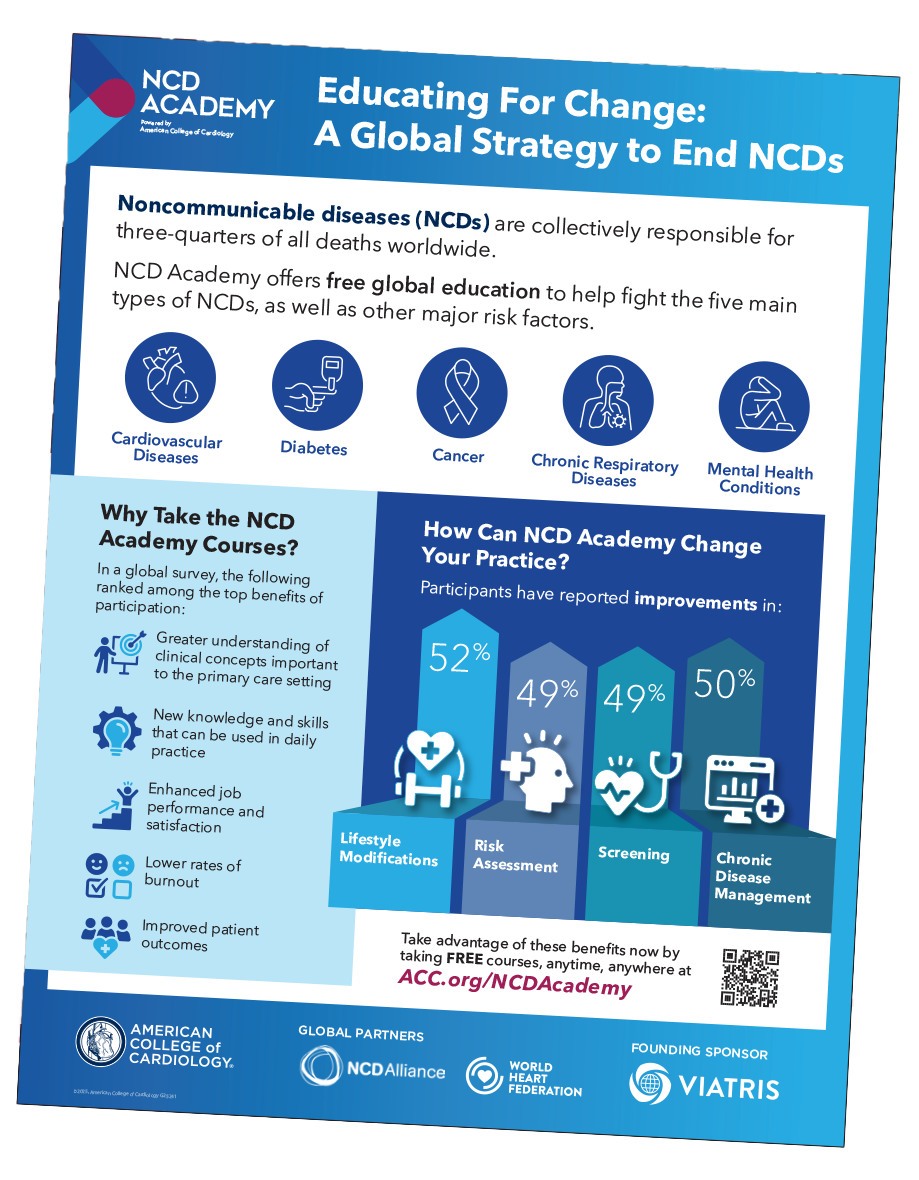
Respondents overwhelmingly rated NCD Academy courses as effective in equipping them with knowledge and skills that can be used in daily practice, as well as providing an understanding of clinical concepts important in the primary care settings. Other benefits included enhanced job performance and improved practice outcomes.
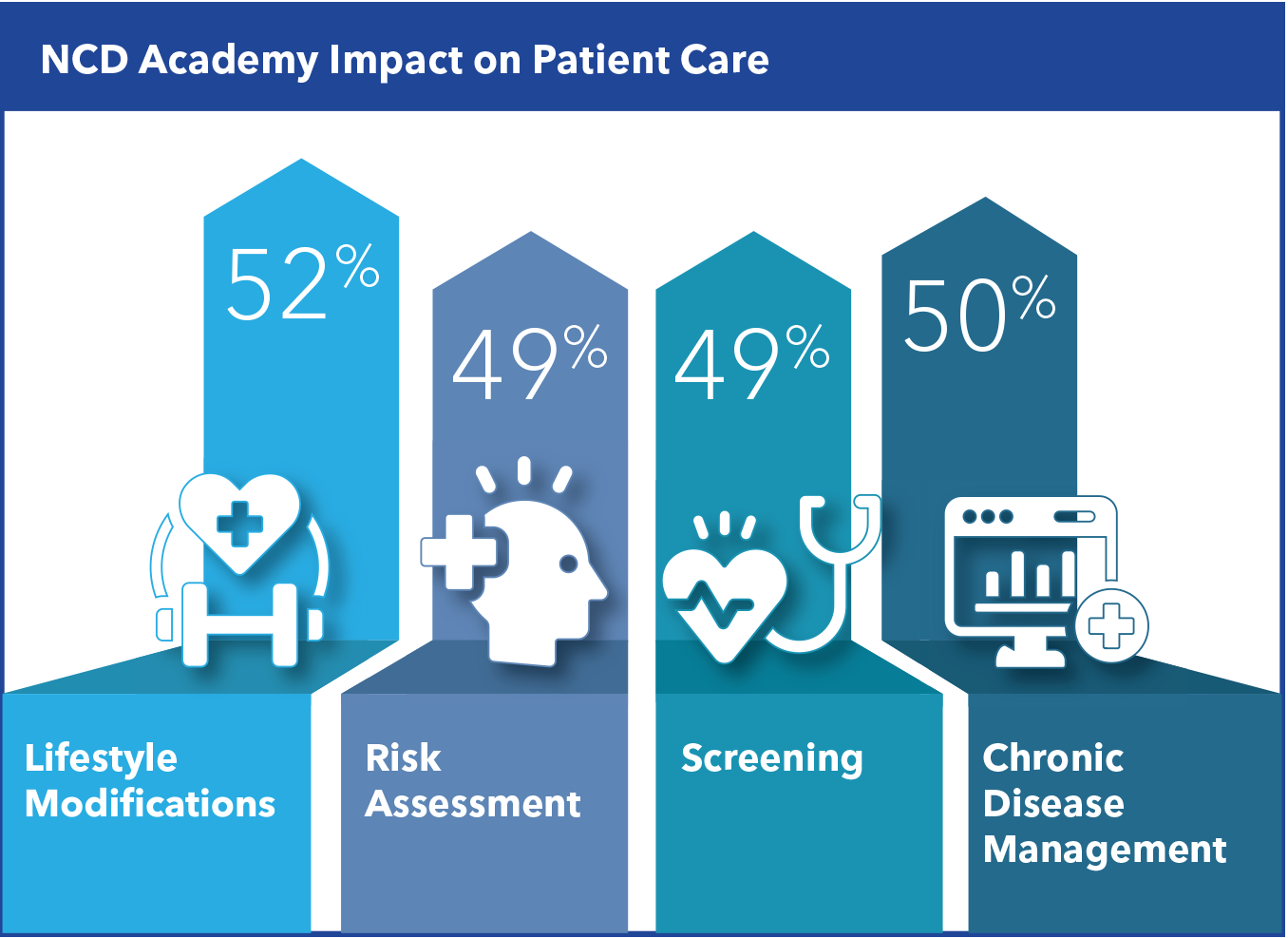
Many participants noted specific practice improvements as a result of the training, including greater integration of lifestyle modification counseling, clinical guideline recommendations, routine screening and risk assessment. Others cited strengthened approaches to patient-centered care, better chronic disease management and increased medication adherence.
While modest, the data also suggest that NCD Academy participants were somewhat more likely to feel valued in their roles and treated fairly at work compared to their nonparticipating peers – further underscoring the potential of continuous, targeted education to support both professional development and clinician well-being.
"NCD Academy provides great support for clinicians in my country," said a family medicine practitioner living in Pakistan. "The free of cost offering makes it accessible since the majority cannot pay huge amounts because of low wages in our country."
Call to Action
The global survey offers a compelling snapshot of the clinician experience across diverse roles and regions, highlighting patterns in job satisfaction, burnout and collaboration. Notably, participation in programs like the NCD Academy appears to be associated with greater confidence, improved clinical practice and a stronger sense of value in the workplace.
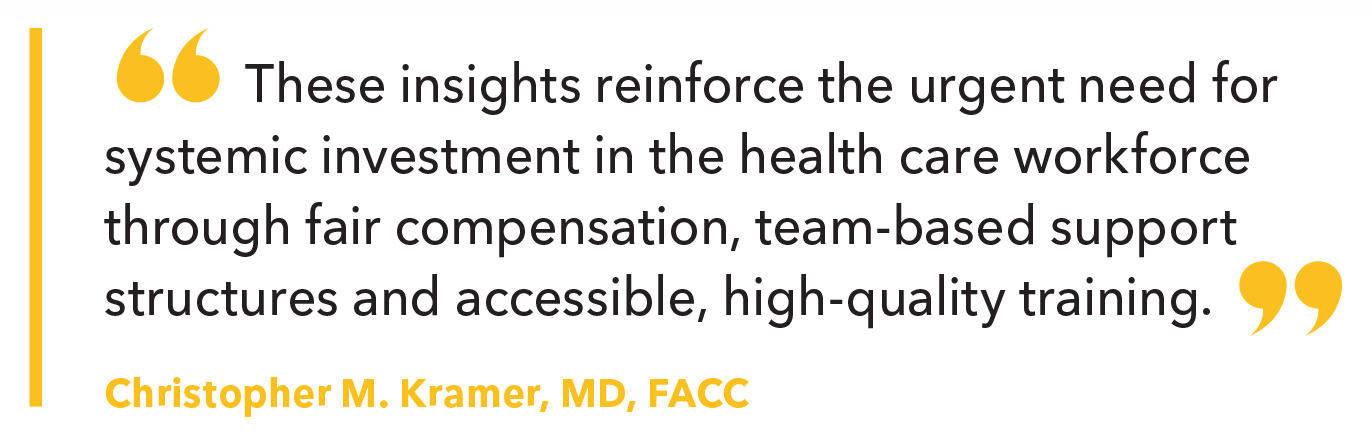
"These insights reinforce the urgent need for systemic investment in the health care workforce through fair compensation, team-based support structures and accessible, high-quality training," says Christopher M. Kramer, MD, FACC. "Expanding access to scalable, evidence-based education and digital health tools, especially in resource-limited settings, has the potential to strengthen both workforce resilience and patient outcomes. As the burden of NCDs continues to rise, policymakers and health system leaders must prioritize the people behind the care, recognizing that supporting clinicians is essential to overcoming systemic barriers and achieving global health goals."
Get Started With NCD Academy
Visit ACC.org/NCDAcademy to access the complete list of courses and download the NCD Academy app for free. Plus, don't miss new "Quick Access Content," covering a variety of critical health topics such as flu, metabolic diseases, digital health solutions and more.
Help spread the word about NCD Academy in your community by sharing the infographic included in this issue with local community health workers, CV Team members and/or primary care clinicians.
Live From the UN General Assembly
The ACC will be hosting two side events during the UNGA meeting this month. The first event, sponsored by Viatris, will explore the critical link between financing, workforce capacity and NCD care. Centered around the theme of the health workforce, the session is designed to foster multi-sectoral collaboration and policy innovation around sustainable, scalable solutions for ensuring equitable, high-quality care for people living with NCDs worldwide.

The second event, which builds upon the ongoing, multi-year collaboration between JACC, the National Heart, Lung, and Blood Institute and the University of Washington's Institute for Health Metrics and Evaluation, will feature data from the latest Global Burden of Disease report, published in JACC, and stress the urgent need for real multilateral progress to mitigate the global impact of NCDs.
"As world leaders gather for the UNGA, the ACC is seizing this pivotal moment to spotlight the progress made in transforming cardiovascular care and advancing heart health worldwide," says ACC President Christopher M. Kramer, MD, FACC, in a new Leadership Page published in JACC. "...Together, we must continue to engage directly with communities affected by NCDs to ensure equitable access to prevention, treatment, and lifelong care. The time to act is now – because every heart matters."
Visit JACC.org to access the Leadership Page along with the special issue on Global Cardiovascular Health, featuring the study from the Global Burden of Disease group entitled "Global, Regional, and National Burden of Cardiovascular Diseases and Risk Factors in 204 Countries and Territories, 1990-2023: A Systematic Analysis for the Global Burden of Disease Study." Look for highlights from the ACC side event on workforce in next month's issue of Cardiology.
Clinical Topics: Cardiovascular Care Team
Keywords: Cardiology Magazine, ACC Publications, Delivery of Health Care, Patient Care Team, Global Health, Workforce, Health Workforce
