How Many ICD Patients Receive Appropriate Shock Therapy By 10 Years?
During the 10 years after receiving an ICD, nearly half of patients received appropriate therapy from the device, according to data gleaned from the Medtronic CareLink database and published Aug. 18 in JACC: Clinical Electrophysiology.
In the study, investigators Anne B. Curtis, MD, FACC, et al., analyzed the records of 237,627 Medtronic recipients (mean age at implantation 63 years; 28% women) of either single- (39%) or dual-chamber (61%) ICD for either primary (80%) or secondary (20%) prevention between 2013-2024.
The average follow-up was 4.4 years post implantation, with a Kaplan-Meier estimated 10-year survival rate of 77%. Three subject matter experts adjudicated a random sample of 595 episodes within the data set to determine whether they were treated appropriately.
Results showed that the primary endpoint, the 10-year cumulative incidence of time to appropriate first shock therapy, antitachycardia pacing (ATP) or any appropriate therapy (either shock or ATP) was 33%, 42% and 48% respectively, compared to an incidence of 8%, 13% and 15% at one year post implantation.
"While the rate of appropriate therapy may be relatively low in the first year or two after implantation, patients receive ICDs to improve outcomes over many years," write Curtis, et al. "The finding that the first therapy may occur many years after implantation is meaningful and highlights the fact that absence of therapy does not equate to absence of risk."
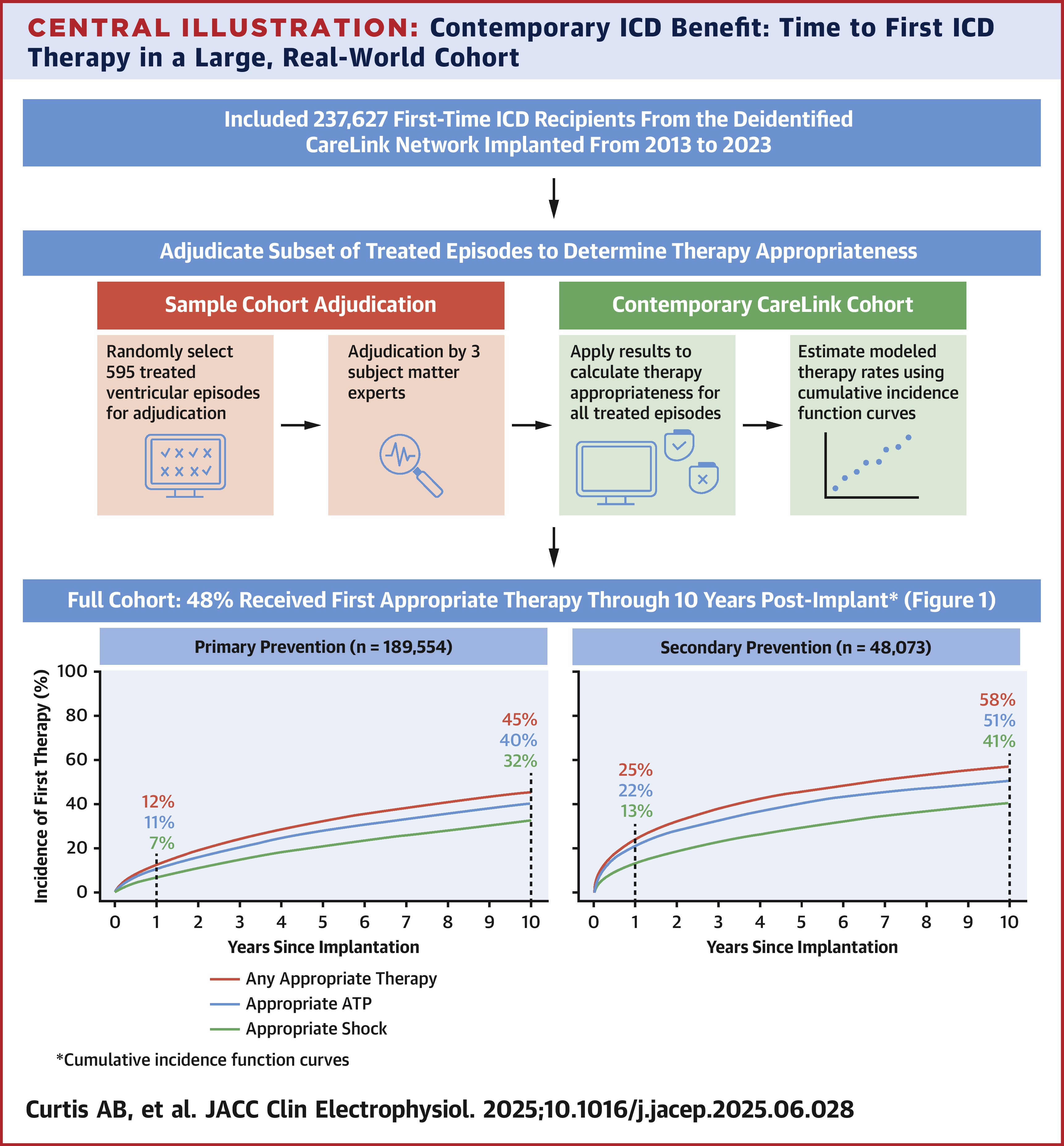
Compared to patients where ICD was indicated for primary prevention, patients with indication for secondary prevention had a higher 10-year cumulative incidence of time to first appropriate shock (32% vs. 41%), ATP (40% vs. 51%) or any therapy (45% vs. 58%), "driven, in part, by the perceived reduced risk of [sudden cardiac death] in primary prevention patients compared with secondary," according to the authors.
"Yet," they add, "our results indicate that the gap in appropriate ICD therapy rates received by primary vs. secondary prevention patients is narrower than one might expect."
Results showed that at one year post implantation, the cumulative incidence of time to first inappropriate therapy was 4% for shock, 5% for ATP and 6% for any therapy, climbing to 19%, 22% and 27%, respectively, at 10 years.
Clinical Topics: Arrhythmias and Clinical EP, Implantable Devices, SCD/Ventricular Arrhythmias, Atrial Fibrillation/Supraventricular Arrhythmias
Keywords: Electrophysiology
< Back to Listings


