From the Member Sections | The Landscape of Cardio-Obstetrics Training: A Cross-Specialty Fellows' Perspective
With the rise in maternal mortality in the U.S. and emerging data on the impact of adverse pregnancy outcomes on lifetime cardiovascular health, there is a growing need for robust cardio-obstetrics exposure during training to ensure the availability of cardiovascular clinicians who are comfortable managing these complex patients. In the absence of a formal accredited training program in cardio-obstetrics, Abra Guo, MD, Sunita Mahabir, MBBS, and Tiffany Corlin, MD, share how they were inspired to create "training programs" of their own embedded within their individual cardiovascular fellowships at the University of Minnesota in Minneapolis.
From Curiosity to Commitment: What Inspired Your interest in Cardio-Obstetrics?
Guo (Third-Year General Cardiology Fellow):
My interest in cardio-obstetrics developed during fellowship. My first encounter with the maternal-fetal medicine (MFM) service was during my first year working in the cardiac intensive care unit, where we cared for a woman who had suffered cardiac arrest from a massive pulmonary embolism and who had recently undergone ovarian stimulation as part of in vitro fertilization. A collaborative valve research project with MFM followed in the next year. These experiences set the stage for opportunities to care for cardio-obstetric patients in inpatient and outpatient settings.
Mahabir (Advanced Heart Failure Fellow):
Before coming to the U.S., I practiced in Trinidad, a resource-limited, third-world country with a high incidence of rheumatic heart disease and adult congenital heart disease. Patients would often present to us in the late stages of pregnancy or after they decompensated after delivery. As a result, there was very high maternal morbidity associated with these pregnancies.
During residency and fellowship, I also became interested in peripartum cardiomyopathy, after observing many cases of young women presenting with cardiogenic shock either during pregnancy or early after delivery. These cases cause understandable anxiety among providers, especially when having to navigate mechanical support and anticoagulation.
Corlin (Third-Year Maternal-Fetal Medicine Fellow and Surgical Critical Care Fellow):
Fellowship and the opportunity to care for a larger number of maternal patients with cardiovascular disease opened my eyes to the need for cardio-obstetrics. As this field expands and advances in medicine continue, there are increasing opportunities to better support this unique population of patients before, during and after childbirth.
Tips For Bringing Cardio-Obstetrics Into Focus During Fellowship?
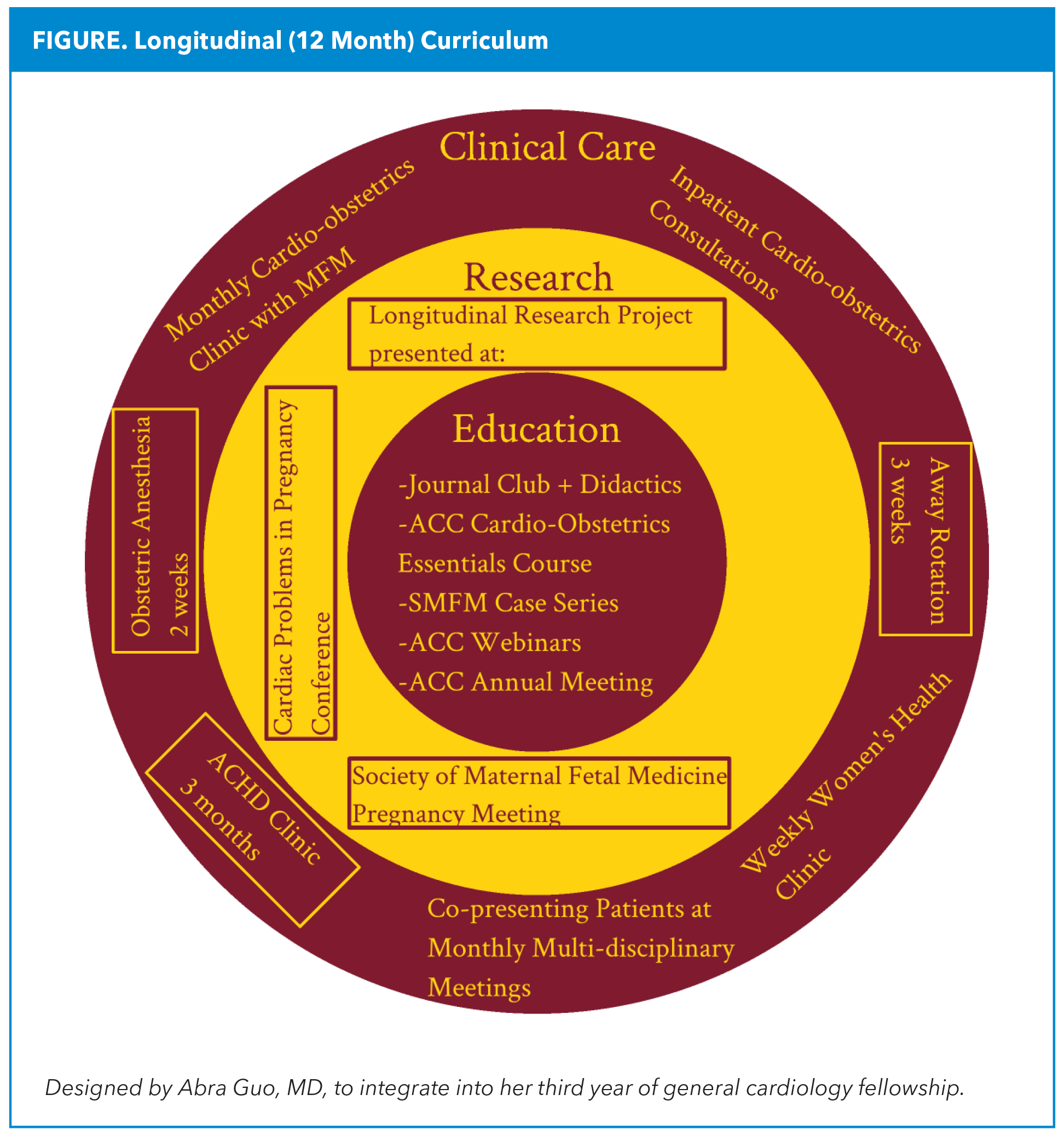
Guo: At the end of my second year, I was looking for more ways to get clinical exposure to cardio-obstetric patients. I found two articles addressing fellowship training in cardio-obstetrics that provided me with a foundation for creating a self-directed one-year curriculum (Figure). One was developed by members of ACC's Reproductive Health and Cardio-Obstetrics Member Section and published in JACC and the other was published in the Debakey Cardiovascular Journal.1,2
Working with mentors in cardiology and MFM, it was possible to meet my goal of exposure to more than 120 cases before the end of fellowship training, equivalent to Level III training, as outlined in the JACC review article. This included rotations in Labor and Delivery with obstetric anesthesia, co-presenting patients during our monthly cardio-obstetrics meeting, attending cardio-obstetrics clinics, seeing consults as well as completing an away rotation at another institution.
Mahabir: Finding mentors with an interest in cardio-obstetrics is key. During my general cardiology fellowship, I aligned myself with mentors who also had an interest in cardio-obstetrics and participated in clinics with them to gain exposure.
I was very fortunate to participate in the monthly cardio-obstetrics clinic during my advance HF year. This clinic, conducted with the MFM team, involves a regular multidisciplinary meeting between the anesthesia, MFM and adult congenital teams to review all cardio-obstetrics patients.
I also gained experience managing cardio-obstetric patients in the inpatient setting, including patients admitted to the intensive care unit with advanced HF. Having two faculty members interested in cardio-obstetrics as part of the advanced HF team has also been tremendously valuable.
My advice to fellows interested in cardio-obstetrics is to gain as much exposure as you can during fellowship, even if it means some away rotations at programs with dedicated cardio-obstetrics clinics.
What's Next For Gao, Mahabir and Corlin?
Guo will join a private practice group in Washington, with a long-term goal of developing a cardio-obstetrics program along with a cardiovascular clinic focused on women's health in collaboration with MFM, as well as promoting awareness in the local community.
Mahabir will be building a cardio-obstetrics program with specialists with an interest in MFM, with a goal of increasing referrals of women with high-risk pregnancies and building awareness among referring clinicians.
Corlin will integrate her experience as a surgical critical care fellow and MFM with the cardio-obstetrics program to support the growing referral base and improve cross-education between both specialties.
Mentors, Advocacy and More!
"There are unique challenges in caring for pregnant patients with either congenital or acquired cardiac disease, and becoming a specialist in this field allows one to take care of a population of patients who may otherwise fall between the cracks," says Corlin. "The physiology of pregnancy, often described as a natural stress test for the heart, can be a window into a patient's future health, leading to an opportunity to improve long-term outcomes for this population."
The ACC's Reproductive Health and Cardio-Obstetrics Member Section provides a dedicated community for networking, mentorship, education and advocacy. With the tremendous growth in the cardio-obstetrics field, the Section aims to transform cardiovascular care and health in women worldwide and provide a place for those with shared interests in the field.
- Learn about and join ACC Member Sections, including the Reproductive Health and Cardio-Obstetrics Section and the Fellows in Training Section.
- Read more about recent Section efforts to advocate for legislative solutions to improve mental health.

Register Now: Cardio-Obstetrics Essentials
"Cardio-obstetrics touches every subspecialty within cardiology, whether it's prevention or cardiogenic shock or more," says Gao. "It's within the purview of every cardiovascular clinician to be able to tailor care for women considering pregnancy as well as during and after pregnancy."
Join cardio-obstetrics experts, including Course Chair Natalie Bello, MD, MPH, FACC, and Course Vice Chair Deirdre J. Mattina, MD, FACC, in Washington, DC, or virtually from Oct. 17 to 19 for ACC's Cardio-Obstetrics Essentials: Team-Based Management of Cardiovascular Disease and Pregnancy. Learn more and register.
References
- Davis MB, Bello NA, Berlacher K, et al. Cardiovascular fellowship training in cardio-obstetrics: JACC Review Topic of the Week. J Am Coll Cardiol 2023;82(18):1792-1803.
- Minhas AS, Goldstein SA, Vaught AJ, et al. Instituting a curriculum for cardio-obstetrics subspecialty fellowship training. Methodist Debakey Cardiovasc J 2022;18(3):14-23.
Keywords: Cardiology Magazine, ACC Publications, Fellowships and Scholarships, Internship and Residency, Maternal Mortality, Pregnancy Outcome, Cardio-Obstetrics
