Online Exclusive | New Procedure to Measure RAP Clinches Heart Tank Victory
Stephen John, MD, emerged as the winner of the ACC.26 Heart Tank Tournament of Champions thanks to his project developing a new ultrasound-based method to measure right atrial pressure (RAP) by imaging the internal jugular vein (IJV) in an upright position.
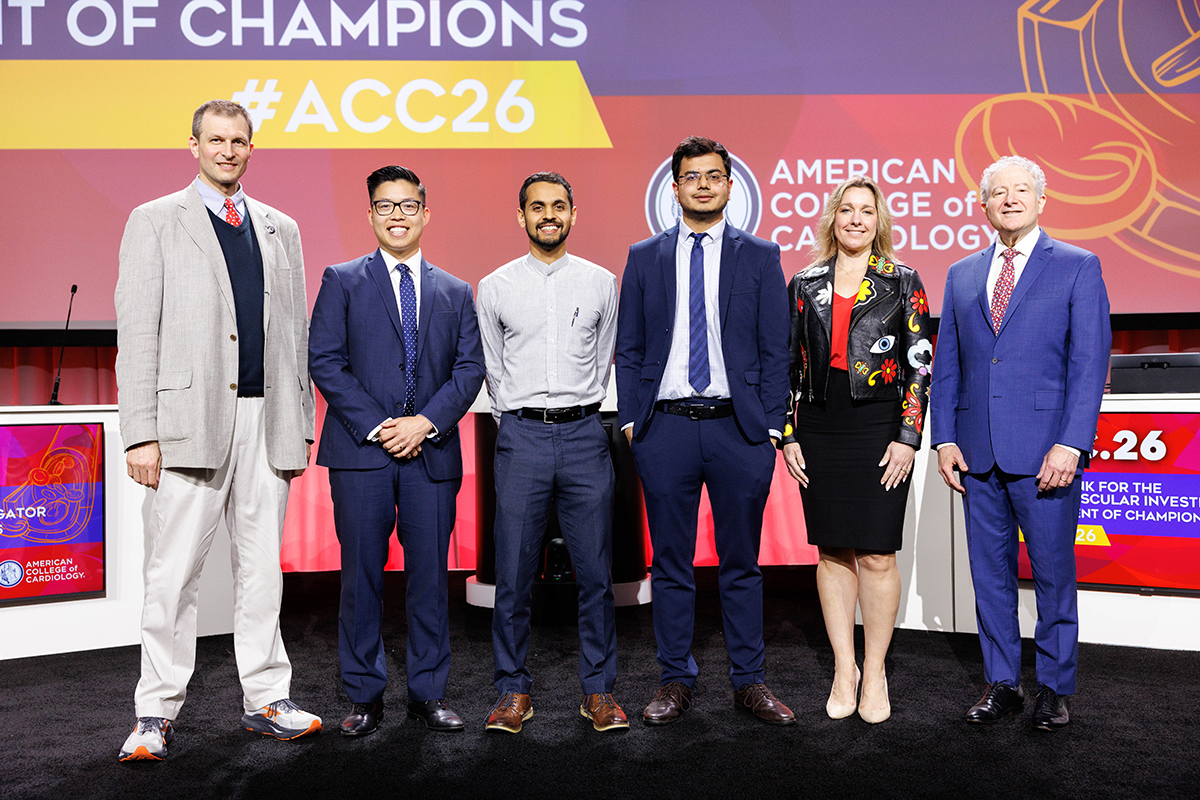
The competition brings together the winners from three Shark Tank-style virtual events focused on intervention, imaging and cardio-oncology to present live pitches at ACC's Annual Scientific Session. Other finalists on this year's Heart Tank stage included Neel Patel, MD, who presented "RAD SAFE: Real-Time, Auditable, Low-Cost Radiation Safety Bundle For the Cath Lab," and Andrew T. Nguyen, MD, whose pitch was titled: "Cancer and Coronary Microvascular Dysfunction: Shared Pathophysiology?"
A general cardiology fellow at UTHealth Houston with a background in mechanical engineering, John centered his Heart Tank presentation on identifying a more accurate way to measure RAP. He attributes his approach to problem solving from techniques he developed while earning his mechanical engineering degree.
"Mechanical engineering uses a problem-solving framework where you identify what your good information is, what your unknowns are and what equations you can use," he says. "That kind of rigor and systematic approach is something I still try to apply in medicine, even though medicine has many more variables."
RAP is traditionally determined with a physical examination and echocardiogram, estimated based on size and collapsibility of the inferior vena cava (IVC). However, published literature reports this method is accurate less than half of the time.
"There is no basis in physics to justify why [the size and collapsibility of the IVC] should correspond with your right atrial pressure," John explains. "We could instead use the Bernoulli equation and a vertical column from the right atrium."
ACC's Academic Cardiology Member Section is in the process of setting the topics for 2027 Heart Tank sessions. Stay tuned for more on next year's competition schedule and calls for research ideas.
John also has developed a YouTube playlist "Echo Explained" to explain the fundamentals of echocardiography in a series of short tutorials for other fellows or sonography students.
The procedure John developed has the patient sit upright at 90 degrees, usually on the side of the bed, then uses US to determine the height of the fluid in the IJV. To get accurate measurements, the clinician must consistently place the probe in the same place without excessive pressure.
For his Heart Tank-winning idea, John received $4,000 to continue his research as well as positive feedback and interest in the procedure from senior cardiologists and other institutions. Currently, he is conducting a single-center study to gather more data, which he plans to complete in the next few months. His goal is to have a report ready to present next year as the Heart Tank judges deliberate at ACC.27-WCC in Houston.
"Step one is to derive the rule and figure out the populations where we can use it. Step two is to validate the rule," John says. "I hope this procedure will be applicable across a large variety of diseases. Physics is physics regardless of whether your heart is strong or weak or what is going on with the blood vessels."
Clinical Topics: Arrhythmias and Clinical EP, Heart Failure and Cardiomyopathies
Keywords: Cardiology Magazine, ACC Publications, CM-May-2026, ACC Annual Scientific Session, ACC26, New Orleans, Awards and Prizes, Atrial Pressure
